SWBG blog
We need a gender transformative budget in tackling the current crises
As the Scottish Government plans for an emergency budget review and Parliament undertakes pre-budget scrutiny on the 2023-24 budget SWBG Coordinator Sara Cowan reflects on what’s needed for a gender transformative budget.
The Covid-19 crisis is not over for communities across Scotland but it is being closely followed by the cost-of-living crisis. Individuals, households and communities are facing uncertain and deeply challenging times while there remains the longer term need to respond to climate change through a just transition.
This year’s Budget and the full economic levers at the Governments disposal must be utilised to mitigate the impact of these crises. To meet Government ambitions to tackle child poverty and deliver a just transition bold and quick action is needed. These crises are not separate issues but require joined up action, for example delivering home retrofitting projects at pace for those on the lowest incomes has an increased level of urgency during the cost-of-living crisis to help lower heating costs and reduce emissions.
It is clear this crisis will not impact everyone equally. Those on the lowest incomes will be hit hardest and women are more likely to experience poverty, have lower levels of savings and wealth and be less able to increase paid work than men due to caring responsibilities. Particular groups of women will be hardest hit, disabled women, women from certain ethnic minority communities, single parents, survivors of abuse and women with no recourse to public funds. As the UK Women’s Budget Group has found women are also often the shock absorbers of poverty, tending to have the main responsibility for the purchase and preparation of food for their children and families and for the management of budgets in poor households.
In February and March 2022, we ran a women's survey. This survey focused on women’s local public spending priorities. It was clear from the responses that the cost-of-living crisis was an issue of key concern. Thirty-two per cent of those who responded said they were unable to manage energy costs before the latest increase on 1 April, and concern about future rises in energy bills was already impacting on people’s household spending.
In open response questions women highlighted the stark challenges they were facing: rising energy prices for carers and those with disabilities who are unable to reduce the heating without impacting their health; covering travel expenses to care for family members outside their household; choosing between heating and eating. Numerous women also highlighted their concern that they were unable to afford any extras to cover new clothes or outings.
While the national Budget is facing pressure decisions must look at how to protect those must vulnerable to the challenges presented by the triple crisis people face.
That’s why we are calling for a gender transformative budget which prioritises:
- Investment in social infrastructure such as care (adult social care and childcare) and those who work in these sectors;
- Delivery of fair work principles and a real living wage focusing on women’s precarious employment;
- Recognition and valuing of unpaid work;
- A caring social security system that provides a genuine safety net when needed most;
- Progressive and fair taxation to support the recovery.
All of which should be delivered with gender analysis informing decision making ensuring that the different experiences of women and men, and different groups of women inform policy and budget decisions.
The Scottish Women’s Budget Group is currently providing written evidence to several Parliamentary committees as part of the pre-budget scrutiny process. Find out more details of these in the responses on our publications page.
The UK Women's Budget Group has produced a short series of briefing papers providing gender analysis of the cost-of-living crisis.
Coming soon, the Scottish Women’s Budget Group is working with the Poverty Alliance researching the impact of the cost-of-living crisis on women on low incomes in Scotland. We will be holding events to share the results in the coming months.
Social infrastructure is the keystone to a healthier, happier, greener and more productive Scotland - STUC/SWBG
First published in: Social infrastructure is the keystone to a healthier, happier, greener and more productive Scotland - STUC/SWBG | The Scotsman (Dave Moxam, STUC Deputy General Secretary and Katie Gallogy-Swan, convenor of the Scottish Women's Budget Group)
What do you think about when you imagine Scotland’s transition to a low-carbon economy?
Perhaps it’s a renewable energy system, expanded public transport or better-insulated housing. To meet decarbonization targets, our physical infrastructure will need to be completely transformed, but what about our social infrastructure?
Social infrastructure comprises all of the life-sustaining work of care, health and education that underpin economic performance and sustain the workforce and society. Without the efforts of workers in these sectors, whether paid or unpaid, the economy would come to a standstill. It is no surprise they were key workers during the pandemic, continuing their duties to keep us safe.
But the pandemic also taught us what happens when we chronically under invest in social infrastructure: it breaks. Understaffed, overworked and underpaid, many key workers and unpaid carers were struggling to keep afloat. The people most dependent on social infrastructure – women, children, people with disabilities and the elderly – suffered. After years of cuts, the resilience of our social infrastructure was eroded, with deadly consequences.
In the first report from Scotland’s new Just Transition Commission released on 14 July, authors highlighted the critical role social infrastructure must play in delivering decarbonization that can also tackle injustice and inequality.
However carefully planned our transition to a greener future, we must anticipate negative shocks. If the pandemic is anything to go by, we are not prepared. Meaningful protection from these impacts demands a major renewal of Scotland's approach to social infrastructure to enhance resilience and adapt to a climate-changed world.
What would this look like?
Firstly, we need to expand the workforce. Decarbonisation will entail enlarging low carbon sectors like care, health and education, as well as decarbonising carbon-intensive employment. A social infrastructure renewal will therefore entail training and upskilling opportunities to bring more people into the sector. If the Scottish Government is serious about a social infrastructure perspective then it needs to reverse plans to cut 30,000 jobs from the public sector. Investment in both physical and social infrastructure is fundamental to transition, but social infrastructure, as a feminised sector, continues to be systemically undervalued in terms of its economic multiplier potential. While both have positive economic multiplier effects, the Women’s Budget Group found investing in care creates 2.7 times as many jobs as the same investment in construction.
But job creation alone will not safeguard a just transition. Workers in social infrastructure jobs are critically undervalued, and the lowest paid of these workers tend to be women, migrants and ethnic minorities. A renewal must be geared to deliver meaningful, well paid and secure employment. A new deal for social infrastructure workers would deliver a package of condition-enhancing measures to indicate their value to the economy and solidify these sectors as promising career pathways. Raising pay in social care to £15 an hour and putting in place a system of national sectoral collective bargaining would be a good place to start.
The many people doing critical but unpaid care work also need a better deal. The Scottish Government should undertake an appraisal of our current social safety net to ensure it is fit for a just transition future, including considering new social protection measures that target unpaid carers and workers affected by decarbonization efforts.
Investment in the creation of skilled and well-paid jobs in social infrastructure will effectively pay for itself in the long run, helping to stabilise public finances as expanded employment in relevant sectors increase household income and tax revenues and lead to multidimensional positive outcomes for communities.
But as it stands, too much of the money going into these services is being siphoned into profits instead of being reinvested into improving delivery and working conditions. A recent report from the Scottish Trades Union Congress (STUC) revealed privatized care services had lower wages, more complaints about care quality and higher levels of rent extraction than public and non-profit care providers. The upcoming National Care Service Bill must place caring infrastructure firmly in the public sphere, with a robust public investment plan and a human-rights-based delivery approach at the local, regional and national level.
None of this will happen with squeezed budgets and depressed wages. Any hope of success in this agenda demands a reversal of real-term cuts to local authorities who lead delivery of many vital public services. Social infrastructure isn’t simply a cost, but an investment in our future. A care indicator should be included on the National Performance Framework and social infrastructure must be a critical pillar of the National Strategy for Economic Transformation to reflect the fundamental role it plays in enabling all other economic activity.
Social infrastructure is the keystone to a healthier, happier, greener and more productive future. It can’t be done on the cheap. Renewal is a no-brainer.
Experiencing a disability premium - experiences shared in our women's survey
Blog by Heather Williams, SWBG Training Lead
This is the third blog in our series looking at what women told us earlier this year when we conducted a survey to find out more about their local public spending priorities, impact of the cost of living crisis and experiences of child and social care.
We heard from women in every local authority area in Scotland. 425 women responded to the survey with a range of life experiences. This blog focuses on the responses of women who disclosed that they had a disability. 87 of the women who completed the survey identified as having a disability.
Our survey highlighted the economic impact and the heightened chance of women experiencing poverty if they have a disability, the numbers with a household income of less than £10.000 is almost 3 times higher for those with disabilities than in the full sample (16.09% compared to 5.65%), while those with a household income of less than £19,999 were more than double the full sample (22.99% compared to 11.53%).
The impact of the current cost of living crisis was also being felt by this group at an increased rate. In comparison to the full data sample on all elements those who identified as disabled stated they struggled to meet costs;
Food costs – 15% higher
Energy costs – 16% higher
Housing costs – 14% higher
Transport costs – 6% higher
Respondents told us that they were concerned about the cost of living increases and that they experienced a disability premium (facing increased costs related to their disability that they struggled to meet):
‘I can't work f/t because of my disability so have a very low-income but because I work there is no help. If my energy bill goes up I can't afford it, I have no more money.’
‘I live with my parents. I'm disabled, but not enough to get PIP. So if it weren't for my parents, I'd be homeless. I can't work enough to earn enough to live on my own. I barely make enough to buy my own food and travel to work. Any increases, like those mentioned above, mean that I am even further from ever being able to survive on my own.’
‘I have a disability which is made worse by cold temperatures. I am fearful about turning my heating on at the moment in case I get a frightening bill. It is preventing me from being able to manage larger payments for repairs in my house.’
Our survey also showed that of those in employment almost double the numbers of disabled women were self-employed while rates of women in full time employment were almost half of that for the full sample.
Of the women who accessed childcare they were paying between £550 and £120 per month towards childcare, depending on circumstances and children’s age, from this it would appear that rates of using childcare are lower in this group which possibly reflects the lower rates of full-time employment and higher rate of self-employment and not working due to their health conditions/disability.
Those who responded to our survey told us that they struggled to manage childcare and household costs at a higher rate than those in our full sample and that for 50% of those who responded their partners did not make any changes to their paid work arrangements in order to manage childcare (this slightly higher rate possibly reflects the higher number of single parents within this group). The impact of managing childcare included:
‘In the past I have struggled to pay childcare fees and found these to be almost as much of a worry as rent.’
‘It is hard to find a childcare space, and communication is sparse. We want our child to have social interaction with other children but cannot afford to send him more than 2 days a week. We are over the earning threshold to qualify for 2 year old funded place by £30 a month. Two days a week at nursery costs £280-£330 a month.’
‘Struggling to get space in after club, a lot time school off no child care, been self-employed and must stop work when no child care access or holiday off from school.’
‘Unable to earn a professional salary and resigned to stay at home due to lack of childcare provision. Tax credits are means tested so do not offset costs of a private childcare provider once you earn over a certain threshold.’
Scottish Women's Budget Group responding to the Resource Spending Review
Last month’s resource spending review presented a stark picture for Scotland’s budget over the coming years. We welcome the fact that health, social care and social security have been prioritised as these are all areas that can have an impact on gender inequality. Measures such as the Scottish Child Payment and changes to Carers Allowance will help address women’s poverty.
However, it would be wrong to assume that this prioritisation will address the problems related to the chronic underinvestment in social care or the impact of the cost of living crisis for those on universal credit and legacy benefits which prior to the crisis was already leading to an increase in women’s and children’s poverty. This resource spending review took place at a time of future uncertainty and required bold action from Government to challenge the rising tide of poverty people are facing as costs keep rising.
Equality and Fairer Scotland Statement
Published alongside the Resource Spending Review was the Equality and Fairer Scotland Statement. The publication of this document is an important statement of intent showing a commitment to equality analysis within the Budget process. Throughout the process of developing the RSR and in each budget cycle equality impact analysis is a vital element to support decision making and help the RSR achieve in its key priority areas. Capacity and support must be provided at an early stage within all government budget processes to ensure that there is transparent analysis of equality impacts throughout.
The statement provided a welcome commitment to fully publishing EQIAs with the next draft budget, we look forward to seeing this detail. As well as committing to work with equality groups and through the Equality Advisory Budget Group to further develop transparency and support scrutiny of budget documentation.
Disappointingly it did not publish any EQIAs that were undertaken as part of the RSR process and there is a lack of transparency over inputs provided to this process despite references to analysis taking place.
The statement took a new format to previous Equality and Fairer Scotland Budget Statements by focusing on 9 Opportunity/Challenge areas. This makes it hard to compare with recent EFSBS that had differing risk areas as a focus. We would urge the Government to focus on one model and take time to develop this. Greater work is needed to link to National Outcomes set out in the National Performance Framework as an important indicator to how Scotland’s spending relates to what we value as a nation.
Social Security
Important commitments are made in the RSR to social security provision. Women are more likely to rely on social security and these provisions are important for Scotland to set out its own path in delivery of social security.
Commitments on the Scottish Child Payment, Carers Allowance Supplement and Disability payments are all vital to supporting people on low incomes. These rates will need to continue to be monitored over the course of the spending review and at mid-year points as inflation already surpasses the 6% rise in social security payments delivered in Scotland set at the start of 2022/23 financial year.
Local Government Spending
It is concerning to see the flat investment in Local Government. Again, an area that has struggled for sufficient funds in recent years. Public services run by local authority’s impact women and men differently. In turn investment in the services can serve to tackle or entrench inequalities. The RSR detailed a flat rate of spending to local authorities, meaning a real term cut of 7% by 2026, this alongside the ringfencing of much of local government budget means there will be little room for manoeuvre on local priorities.
Within the tight financial envelope that exists for spending in Scotland options to raise revenue fairly must be further explored. Including power for local authorities to raise revenue from new sources and reform of local taxation to build fairness into the system. Mechanisms to raise revenue must be explored from the point of view of how they can also work to tackle inequalities.
Without the necessary/appropriate resources local government will not be able to meet its functions to deliver equality locally.
Public Sector Pay
The RSR makes important recommitments to the need to deliver fairwork to those in the public sector. This a crucial commitment and delivering this for the lowest paid workers must be made a priority of Government.
Reducing the size of the public sector workforce is outlined alongside commitments on increasing teacher numbers and investment in care. More clarity is needed on this along with a commitment to protect frontline staff, many areas such as care need significantly greater investment in staff numbers.
The majority of public sector staff are women so changes to the sector are inherently gendered, particularly if cuts are made to frontline provision. Clear equality impact analysis of decisions made on public sector pay and staffing levels are necessary to understand the gendered impact of cuts to the public sector size as well any improvements brought about through delivery of Fairwork principles.
Women's experiences of childcare shared through our survey
This is the second blog in our series by Heather Williams looking at what women told us earlier this year when we conducted a survey to find out more about their local public spending priorities, impact of the cost of living crisis and experiences of child and social care.
We heard from women in every local authority area in Scotland. 425 women responded to the survey with a range of life experiences.
Impact of childcare
Our survey showed the disparity in responsibility for childcare arrangements with over 80% of women who responded having made some change to their paid work arrangements to manage childcare arrangements while less than 40% of their partners made any changes.
Women told us that in order to manage childcare that they had to make changes as follows:
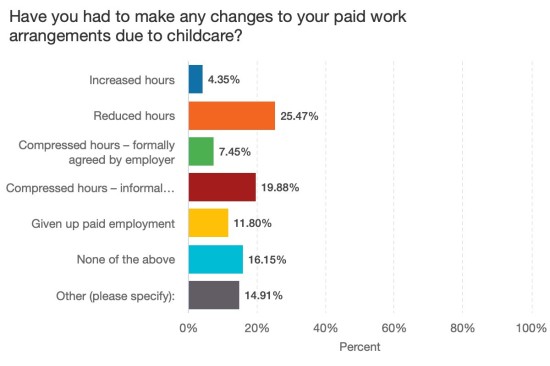
Women told us that having to juggle work and childcare impacts on the paid work they can do (58.12%), has affected their physical health (26.25%), impacted on their mental health (55.62%) and on their financial wellbeing (51.25%)
‘I have 2 children with no family network close by to help with childcare. There is a lack of availability around care that is affordable. The only provider to offer this requires a 52 week of the year contract with a minimum number of days a week - ie you must take a 3 day week contract for 52 weeks even if you only need 2 days term time. The hours of childcare do not accommodate shift work and I have had to move jobs as my employer at that time offered no flexibility - I was unable to finish work at 5pm and rely on public transport to ensure my child was collected by 5.30pm. I also am unable to take work with an earlier start due to the lack of childcare before 8am.’‘The high cost of childcare means I can only send my 2 year old to nursery 2 days a week this results in less time to do paid work and less time to manage the household effectively.’
‘I have struggled to find work due to be unable to afford private childcare and the funded childcare available to me not being flexible and employers expecting people to be fully flexible and work different hours each week.’
‘I am the only adult in the household so all childcare responsibility is on me, this is very detrimental to my health and well-being at times. Especially during school holidays. I find I use all of my entitled Annual leave purely for child care.’
‘I am constantly having to try to swap shifts to manage my childcare months in advance to work around family schedules. It is predominantly myself that this affects as it seems to be that as the female I am responsible for this. I have already had to change job once due to childcare issues and I am now going to have to change jobs again due to childcare. It is very stressful, impacting on my emotional well-being, my stress, my general health, my job prospects as since I have had a child I cannot stay anywhere long enough to progress and therefore also my self-esteem.’
We asked women about their experiences of accessing the 1140 hours free childcare for over 3’s, 41 of those who responded were entitled to access this, of these 29 were able to access the hours and 12 weren’t, this was primarily due to hours of availability not matching hours of work.
We asked those who were able to access the free hours how well it met their needs and for more than 2/3rds of those entitled to these hours the way these are delivered in their local area does not cover their childcare requirements, again this was due to a lack of flexibility in delivery.
‘We have been able to access these hours since August and it has made a huge difference to our budget. We are only able to use our full provision in a council nursery because of family support and flexible employers and this means that we do not pay any charges for our youngest child this year. We were entitled to the hours from August 2020, but in the year 2020/21 we were unable to access our full provision in a council nursery, and had to pay significant top up fees to have our child in a private nursery two days a weeks to cover our working hours and in fact because of the way private nurseries calculate their charges we were paying for 2-3 hours of provision that we did not need every day that our child was in nursery. I don't think the council really understand the financial implications for parents of using their hours in a private setting. It's good to have the flexibility to choose that option, but there needs to be the option to put your child in a setting that does not attract additional charges too. I'd like to see council settings moving toward greater flexibility in the hours they operate. At the moment ours operates 8.45-2.45 and we can only make that work for us because we are working from home/have flexible employers/have family support.’‘We get two regular days but additional hours are made up by ad hoc days which doesn’t allow me to work more hours regularly. School hours are such that we need to pick our older child up from school so can’t work during hours available at nursery.’
‘I'd prefer to have more flexibility in how we use the hours without attracting additional costs. The 30 hours are sufficient to cover the hours that my partner and I both work, but because of the fixed times when we are able to access them we still rely on family to provide wrap-around care two days per week.’
‘Hours are very ridged and do not cover full year round as some nurseries do not operate as 52weeks. If I choose to work I would still have to pay some fees and once this is added onto all other expenses in life it really has a huge impact on overall health and well-being of both the adult and the child.’
‘My son is due to start council school nursery next week however despite me applying for a morning space Monday to Friday he has only been offered afternoons Monday to Friday meaning I cannot get a job starting work before 2pm and cannot work later than 6pm due to lack of childcare however if I had morning nursery I could mornings while he is at nursery and afternoons when my mum is finished work and able to help.’
The commitment to provide 1140 hours of childcare to over 3s helps many women to undertake paid work and addresses the barrier this can create for many. However the lack of capacity in some areas, a lack of flexibility in how this is provided and a lack of wrap around care leaves many gaps that are often filled by other women providing unpaid care.
 RSS
RSSMailing list
To join our email list, simply enter your email address below.