SWBG blog
Scottish Women's Budget Group responding to the Resource Spending Review
Last month’s resource spending review presented a stark picture for Scotland’s budget over the coming years. We welcome the fact that health, social care and social security have been prioritised as these are all areas that can have an impact on gender inequality. Measures such as the Scottish Child Payment and changes to Carers Allowance will help address women’s poverty.
However, it would be wrong to assume that this prioritisation will address the problems related to the chronic underinvestment in social care or the impact of the cost of living crisis for those on universal credit and legacy benefits which prior to the crisis was already leading to an increase in women’s and children’s poverty. This resource spending review took place at a time of future uncertainty and required bold action from Government to challenge the rising tide of poverty people are facing as costs keep rising.
Equality and Fairer Scotland Statement
Published alongside the Resource Spending Review was the Equality and Fairer Scotland Statement. The publication of this document is an important statement of intent showing a commitment to equality analysis within the Budget process. Throughout the process of developing the RSR and in each budget cycle equality impact analysis is a vital element to support decision making and help the RSR achieve in its key priority areas. Capacity and support must be provided at an early stage within all government budget processes to ensure that there is transparent analysis of equality impacts throughout.
The statement provided a welcome commitment to fully publishing EQIAs with the next draft budget, we look forward to seeing this detail. As well as committing to work with equality groups and through the Equality Advisory Budget Group to further develop transparency and support scrutiny of budget documentation.
Disappointingly it did not publish any EQIAs that were undertaken as part of the RSR process and there is a lack of transparency over inputs provided to this process despite references to analysis taking place.
The statement took a new format to previous Equality and Fairer Scotland Budget Statements by focusing on 9 Opportunity/Challenge areas. This makes it hard to compare with recent EFSBS that had differing risk areas as a focus. We would urge the Government to focus on one model and take time to develop this. Greater work is needed to link to National Outcomes set out in the National Performance Framework as an important indicator to how Scotland’s spending relates to what we value as a nation.
Social Security
Important commitments are made in the RSR to social security provision. Women are more likely to rely on social security and these provisions are important for Scotland to set out its own path in delivery of social security.
Commitments on the Scottish Child Payment, Carers Allowance Supplement and Disability payments are all vital to supporting people on low incomes. These rates will need to continue to be monitored over the course of the spending review and at mid-year points as inflation already surpasses the 6% rise in social security payments delivered in Scotland set at the start of 2022/23 financial year.
Local Government Spending
It is concerning to see the flat investment in Local Government. Again, an area that has struggled for sufficient funds in recent years. Public services run by local authority’s impact women and men differently. In turn investment in the services can serve to tackle or entrench inequalities. The RSR detailed a flat rate of spending to local authorities, meaning a real term cut of 7% by 2026, this alongside the ringfencing of much of local government budget means there will be little room for manoeuvre on local priorities.
Within the tight financial envelope that exists for spending in Scotland options to raise revenue fairly must be further explored. Including power for local authorities to raise revenue from new sources and reform of local taxation to build fairness into the system. Mechanisms to raise revenue must be explored from the point of view of how they can also work to tackle inequalities.
Without the necessary/appropriate resources local government will not be able to meet its functions to deliver equality locally.
Public Sector Pay
The RSR makes important recommitments to the need to deliver fairwork to those in the public sector. This a crucial commitment and delivering this for the lowest paid workers must be made a priority of Government.
Reducing the size of the public sector workforce is outlined alongside commitments on increasing teacher numbers and investment in care. More clarity is needed on this along with a commitment to protect frontline staff, many areas such as care need significantly greater investment in staff numbers.
The majority of public sector staff are women so changes to the sector are inherently gendered, particularly if cuts are made to frontline provision. Clear equality impact analysis of decisions made on public sector pay and staffing levels are necessary to understand the gendered impact of cuts to the public sector size as well any improvements brought about through delivery of Fairwork principles.
Women's experiences of childcare shared through our survey
This is the second blog in our series by Heather Williams looking at what women told us earlier this year when we conducted a survey to find out more about their local public spending priorities, impact of the cost of living crisis and experiences of child and social care.
We heard from women in every local authority area in Scotland. 425 women responded to the survey with a range of life experiences.
Impact of childcare
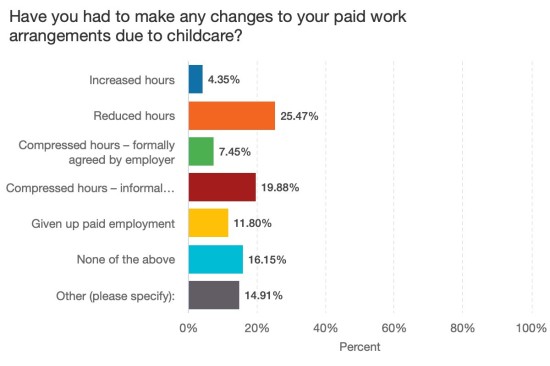
Our survey showed the disparity in responsibility for childcare arrangements with over 80% of women who responded having made some change to their paid work arrangements to manage childcare arrangements while less than 40% of their partners made any changes.
Women told us that in order to manage childcare that they had to make changes as follows:
Women told us that having to juggle work and childcare impacts on the paid work they can do (58.12%), has affected their physical health (26.25%), impacted on their mental health (55.62%) and on their financial wellbeing (51.25%)
‘I have 2 children with no family network close by to help with childcare. There is a lack of availability around care that is affordable. The only provider to offer this requires a 52 week of the year contract with a minimum number of days a week - ie you must take a 3 day week contract for 52 weeks even if you only need 2 days term time. The hours of childcare do not accommodate shift work and I have had to move jobs as my employer at that time offered no flexibility - I was unable to finish work at 5pm and rely on public transport to ensure my child was collected by 5.30pm. I also am unable to take work with an earlier start due to the lack of childcare before 8am.’‘The high cost of childcare means I can only send my 2 year old to nursery 2 days a week this results in less time to do paid work and less time to manage the household effectively.’
‘I have struggled to find work due to be unable to afford private childcare and the funded childcare available to me not being flexible and employers expecting people to be fully flexible and work different hours each week.’
‘I am the only adult in the household so all childcare responsibility is on me, this is very detrimental to my health and well-being at times. Especially during school holidays. I find I use all of my entitled Annual leave purely for child care.’
‘I am constantly having to try to swap shifts to manage my childcare months in advance to work around family schedules. It is predominantly myself that this affects as it seems to be that as the female I am responsible for this. I have already had to change job once due to childcare issues and I am now going to have to change jobs again due to childcare. It is very stressful, impacting on my emotional well-being, my stress, my general health, my job prospects as since I have had a child I cannot stay anywhere long enough to progress and therefore also my self-esteem.’
We asked women about their experiences of accessing the 1140 hours free childcare for over 3’s, 41 of those who responded were entitled to access this, of these 29 were able to access the hours and 12 weren’t, this was primarily due to hours of availability not matching hours of work.
We asked those who were able to access the free hours how well it met their needs and for more than 2/3rds of those entitled to these hours the way these are delivered in their local area does not cover their childcare requirements, again this was due to a lack of flexibility in delivery.
‘We have been able to access these hours since August and it has made a huge difference to our budget. We are only able to use our full provision in a council nursery because of family support and flexible employers and this means that we do not pay any charges for our youngest child this year. We were entitled to the hours from August 2020, but in the year 2020/21 we were unable to access our full provision in a council nursery, and had to pay significant top up fees to have our child in a private nursery two days a weeks to cover our working hours and in fact because of the way private nurseries calculate their charges we were paying for 2-3 hours of provision that we did not need every day that our child was in nursery. I don't think the council really understand the financial implications for parents of using their hours in a private setting. It's good to have the flexibility to choose that option, but there needs to be the option to put your child in a setting that does not attract additional charges too. I'd like to see council settings moving toward greater flexibility in the hours they operate. At the moment ours operates 8.45-2.45 and we can only make that work for us because we are working from home/have flexible employers/have family support.’‘We get two regular days but additional hours are made up by ad hoc days which doesn’t allow me to work more hours regularly. School hours are such that we need to pick our older child up from school so can’t work during hours available at nursery.’
‘I'd prefer to have more flexibility in how we use the hours without attracting additional costs. The 30 hours are sufficient to cover the hours that my partner and I both work, but because of the fixed times when we are able to access them we still rely on family to provide wrap-around care two days per week.’
‘Hours are very ridged and do not cover full year round as some nurseries do not operate as 52weeks. If I choose to work I would still have to pay some fees and once this is added onto all other expenses in life it really has a huge impact on overall health and well-being of both the adult and the child.’
‘My son is due to start council school nursery next week however despite me applying for a morning space Monday to Friday he has only been offered afternoons Monday to Friday meaning I cannot get a job starting work before 2pm and cannot work later than 6pm due to lack of childcare however if I had morning nursery I could mornings while he is at nursery and afternoons when my mum is finished work and able to help.’
The commitment to provide 1140 hours of childcare to over 3s helps many women to undertake paid work and addresses the barrier this can create for many. However the lack of capacity in some areas, a lack of flexibility in how this is provided and a lack of wrap around care leaves many gaps that are often filled by other women providing unpaid care.
SWBG Women's Survey results are in
Blog by Heather Williams, SWBG Training Lead
Earlier this year we conducted a survey of women in Scotland to find out more about their local public spending priorities, impact of the cost of living crisis and experiences of child and social care.
We heard from women in every local authority area in Scotland. 425 women responded to the survey with a range of life experiences.
Women told us that they didn’t think local authorities were taking women’s different needs into account when they made decisions, how cuts in services had impacted on them, that the cost of living crisis (even ahead of the energy increase in April) was worrying many and impacting on their spending decisions, and that caring responsibilities was impacting on their physical and emotional health as well as on their finances.
Read a detailed breakdown of the survey results.
Local Authority Priorities
Ahead of the recent local authority elections we asked women to rank what they thought should be the top 3 priorities of local authorities. They told us that addressing poverty, particularly in relation to the cost of living crisis many are experiencing, was the key area they felt local authorities should be focussing on. Followed by addressing the impact of the pandemic through improving responses to children’s mental health and wellbeing and adult social care.
Women from across Scotland told us that the changes made to service provision as a result of Covid was still negatively impacting on them and those they care for and it was important to get service’s operating again.
‘After school care is yet to return to pre-lockdown levels - I lost my job as I couldn’t manage childcare and working full time. Current employers are more understanding but my post has become temporary until I can commit to being able to work 9-5 five days a week by end of the year, which I cannot as still don’t have after school care available or breakfast club from 8’
‘Social care remains in complete meltdown due to previous disinvestment and the impact of the pandemic. As a result, I have no idea what would happen to my profoundly disabled husband if I get sick…. or worse. No one can answer this question. It’s a heavy worry which keeps me awake at night, it has been part of the reason we’ve remained tied to our home during this never-ending crisis.’
Cost of Living Crisis
Our survey was undertaken ahead of the energy price rise in April yet 32% of those who completed the question on increasing prices told us they were already struggling to afford energy costs. 45% told us they were having to make changes to other household spending to afford energy prices. Respondents told us they were switching heating off, or only having it on for a limited period to manage costs.
‘Living in an all-electric house, it's hard to achieve any level of cosiness however much you spend. My monthly DD has gone up from £45 to £73 pcm in one fell swoop and I'm dreading the price rise due in April. KWs produced by oil or gas radiators are far more efficient at heating. So it's not worth paying the extortionate prices; when I'm home, I wear multiple layers (including a hat), wrap myself in wraps and throws and have a hot water bottle. I heat the bathroom when I have a shower and put the heating on in the living room for a couple of hours in the evening.’
22% were struggling to manage food costs and almost 43% were having to make changes to other household spending to afford food costs. Respondents told us they were changing where they shop, buying cheaper brands or cutting back on buying certain goods.
‘The cost of food has gone up dramatically that I’m having to make a budget and I have cut down on what I thought were basics like cheese because the price has gone up dramatically.’
‘I had to leave the supermarket check-out leaving the shopping behind me or put few items away to afford the shopping, very embarrassing.’
Those who live in rural areas or those who have a disability told us that their ability to make savings was limited due to the additional costs associated with where they stayed or their disability.
‘Energy costs have increased during the winter months - meaning I have to choose between turning the heating on to keep my baby warm or being able to afford proper food for my baby. Transport costs are making it difficult to get into work on time, especially as local public transport is often late or cancelled.’
‘The diet has changed, my daughter has allergies and only certain foods can be bought - which are priced high! As a minority ethnic woman I have to travel into the city to buy certain food supplies - the cost of travel and food are felt much harder now so I try and forgo items. Life should not be about sacrifices all the time.’
‘I have a disability which is made worse by cold temperatures. I am fearful about turning my heating on at the moment in case I get a frightening bill. It is preventing me from being able to manage larger payments for repairs in my house.’
Women went on to tell us more about their experiences of child care and social care. We’ll share more on these experiences in this short series of blogs.
Read the full breakdown of the survey results.
The survey was undertaken between 9th February and 10th March 2022, 425 women from across Scotland responded.
5 principles to drive local action for a gender equal economy
Today we are launching our pre-local election report, Local Spending and Women’s Equality.
Our short paper sets our 5 principles for prospective Councillors to deliver against to help build a gender equal economy.
Councils elected in 2022 have a triple set of challenges to contend with. The cost of living crisis which is rapidly impacting people’s lives, Covid-19 pandemic recovery which impacted many Council run services and the need for practical action on climate change.
To deal with the multiple challenges we’ve set out 5 principles which aim to guide responses that will build in equality:
- Hardwire gender analysis into decision making
- Recognise the gendered nature of poverty
- Build local communities that put care and wellbeing at the centre
- Embrace participation and hear from a diverse range of women
- Understand the role of revenue raising in tackling inequality
With energy prices soaring, managing to get by as the cost of living outstrips wages and social security is a key concern. SWBG conducted a survey between February and March 2022 in which 425 women participated.
The survey demonstrated that the rising cost of living was already having an impact and women are having to make difficult decisions on heating, eating, transport and more. 32% of those who responded said they were unable to manage energy costs before the latest increase on 1 April, and concern about future rises in energy bills was already impacting on people’s household spending.
My husband is disabled, and has been shielding. Our heating costs are higher because he is largely confined to the house, and we will have to cut back on other day to day spend to manage this.
I have no savings left, no chance to find a better paid job due to my caring role. As people go back to the office, this further reduces the jobs open to me due to the continued high prevalence of Covid which restricts our lives.
Energy costs and transport are our highest expenditure after mortgage payments, and these two items take up 80% of my take-home pay. We have very little left to cover food and we are unable to spend on 'fun' activities, holidays etc as a consequence. I am very aware that this is limiting my children's childhood experiences.
Councillors elected in May will have a challenging job to support local communities through these difficult times. Working to build equality into the system in the face of these challenges is a first step building fair communities that work for everyone.
Read the full paper.
If you would like an accessible copy of the paper please contact us on info@swbg.org.uk
Responding to the Spring Statement
Blog by Heather Williams, SWBG Training Lead
When the Chancellor Rishi Sunak made his Spring Statement on Wednesday (23/3/22) he provided little relief for the many people already struggling with rising prices and low incomes.
According to the Women’s Budget Group analysis of the spring statement this year’s Spring Statement took place against the background of a rapidly growing cost of living crisis which will have severe consequences to people’s incomes. With the cost of essentials like food and energy going up, and to public services and public sector pay, as departmental cash settlements were agreed back in the autumn when inflation forecasts were expected to be half of today’s rates.
The Office for Budget Responsibility (OBR) is forecasting that inflation will reach a high of 8.7% in the fourth quarter of 2022 and will average 7.4% in the 2022/23 financial year - its highest rate for 40 years. This is nearly double the inflation forecast in October 2021.
SWBG carried out a women’s survey over February and March this year which highlights some of the ‘hard choices’ women are already making. For 32% of women who recently told us that they struggled to pay their energy costs and were already making the choice to switch off their heating this Spring Statement is unlikely to allay their fears about their ability to heat their homes or cope with the forthcoming energy price rise. For women with an income of under £10,000 this Statement leaves them with even less room to manoeuvre, our survey showed that 75% (of those who responded with an income of less than £10000) were struggling to manage energy costs and 58% had difficulty affording food.
Our survey of women across Scotland showed that a substantial number of those who took part were already struggling to afford rising costs. As such were switching off heating and missing meals or were having to make decisions to cut back on other spending to afford essentials such as food, energy, housing and public transport costs.
Women also told us about how they were cutting back on spending on winter clothes, leisure activities and home improvements to manage everyday costs as budgets are squeezed.
‘I have a disability which is made worse by cold temperatures. I am fearful about turning my heating on at the moment in case I get a frightening bill. It is preventing me from being able to manage larger payments for repairs in my house.’
‘Due to anxieties around energy costs, I've cut back on spending on winter clothing and shoes’
The Chancellor’s actions benefit the richest more than the poorest and will disproportionately benefit better off men, it leaves women yet again hardest hit.
Notes
The SWBG conducted an online survey between 9th February and 14th March 2022, 425 women from across Scotland completed the survey.
 RSS
RSSMailing list
To join our email list, simply enter your email address below.