SWBG blog
Reaction to the Scottish Budget 2026-27
This blog will be updated over the coming days as we take time to go through the budget documentation.
Today’s budget made some important steps but lacked transformative action for women.
On taxes, we welcome the introduction of additional council tax bands for those in high value properties. Yet, today’s announcements shy away from delivering full scale reform, and revaluation remains essential to ensure fairer local taxes capable of adequately funding local services. The introduction of a private jet tax is also a positive step, targeting some of the wealthiest individuals for their highly polluting journeys and reinforcing the Government’s mission to addressing the climate emergency.
On the spending side, this budget contained several key announcements which, while welcome, fall short of ambition. SWBG joined many anti-poverty charities in calling for Scottish Child Payment to rise to £40 per week. The commitment to implement this increase for children under one is a step in the right direction but must quickly be followed with eligibility for all children.
We were disappointed by the absence of any funding to fulfill the Scottish Government’s commitment to end non-residential social care charging. The difference between statements made in today’s budget on social care funding and the reality of rising charges and tightening eligibility at the local level highlights the persistent gulf between the social care budget and the investment actually needed. The percentage increase in social care spending lags behind that of the NHS. It remains to be seen if this spending will resolve the NHS’ performance challenges; however, the absence of a focus on social care, which is also preventative, will only increase pressure on the NHS.
On childcare, this budget appears to increase the focus on school aged provision, with the announcement of a national breakfast club offer in all primary schools and the expansion of after-school activities clubs for children. This is an important development that will be welcomed by families across Scotland, particularly women, who disproportionally bear the brunt of balancing paid work and caring responsibilities. However, this announcement falls short of the Scottish Government’s commitment to deliver a national school age childcare system by the end of this Parliament, with the deadline now pushed to August 2027.
By contrast, Early Learning and Childcare (under 5s) sees no change, despite calls for reform to allow children to access their funded entitlement when they turn three, rather than from the following term. Meanwhile, the original ambition to develop an ELC system from one onwards appears to have faded, with no further news on support for eligible children or on widening the criteria for eligible two-year-olds to help close the attainment gap.
Today’s budget continues to adopt the traditional outlook of economic growth and the transition from oil and gas industries. Supporting workers in oil and gas to reskill to work in renewables is positive, but it falls short from transformative change, both in terms of increasing women’s representation in these sectors and widening our understanding of the economy. The omission of care as a key economic driver is glaring, undermining its role in supporting a well-functioning economy and forming a crucial part of the country’s social infrastructure.
Finally, alongside tax and spending measures, the budget announced £1.5 billion in efficiencies through Public Sector Reform. At SWBG, we have consistently stressed that such reforms must not exacerbate gender inequality. We will be reviewing the details over the coming days to assess the potential impact.
Women’s Voices on Pre-Budget Scrutiny: Perspectives from the Women’s Economic Empowerment Group
In the run up to the introduction of the Scottish budget for 26-27, our Women’s Economic Empowerment group looked at the pre-budget scrutiny undertaken by two parliamentary committees: the Health, Social Care and Sport Committee and the Local Government, Housing and Planning Committee.
The pre-budget scrutiny process aims to give committees greater influence on the formulation of the budget, improve transparency and raise public understanding and awareness of the budget.
Health, Social Care and Sport Committee
The Health, Social Care and Sport Committee chose to look at mental health spending and how decisions on this area supported the delivery of the government’s priorities.
The Health, Social Care and Sport committee conducted its pre-budget scrutiny by issuing a general call for evidence that ran from 26th to 15th June. They also wrote directly to all health and social care partnerships requesting information. The call for evidence received 51 responses, 39 of which were from organisations. Additionally, the Committee held three evidence sessions hearing from eight people: three academics, three public sector workers and two representatives from the third sector, only one of whom was a woman.
The women who took part in our session queried why the committee didn’t hear directly from people with lived experience as part of their pre-budget scrutiny. They felt this could have aided the committee’s understanding about the way decisions taken to balance budgets had impacted on individuals who relied on services and those who provided care. This could have provided additional insight into how well current funding was helping to achieve the Government’s priorities.
The group also felt the language used in the evidence sessions and in the recommendations made by the committee could have been more accessible.
The committee’s findings on the need for greater transparency in order to “follow the money”, and to increase the focus on the outcomes achieved from this investment, echo what the group had learned about the key principles of gender budgeting, and highlight that these are essential if budgets are to drive change and achieve government priorities.
Given members of the group’s varying experiences of accessing services, and the postcode lottery that has developed, they are particularly interested in hearing the Government’s response to the committee’s call for the ring-fencing of certain elements of funding.
The group felt that the need for greater accountability, and for better linking of decisions taken at a local level to achieving the priorities set out by Government, is essential if individuals in communities across Scotland are to experience better outcomes.
Local Government, Housing and Planning committee
The Local Government, Housing and Planning committee sought to understand how the Scottish budget supports the Scottish Government and Local Government’s ambition to “work together strategically to advance public service reform”.
This committee took a different approach to their scrutiny. They wrote to key stakeholders inviting them to provide evidence. This closed call for evidence limited who the committee heard from.
The group were interested in why the committee decided to limit who they invited to hear from as part of their pre-budget scrutiny, and how this might have impacted on the breadth of evidence they heard.
The committee found that, while the Scottish Government is aiming to change public services ‘to be preventative, to better join up and be more efficient’, increased demand was impacting budgets and reducing the funding available for preventative approaches. The committee recommended that the budget must recognise the challenges of increased demands for councils’ services, in particular social care delivery.
Conclusion
While the two committees took slightly different approaches, a key question from members of the Women’s Economic Empowerment project was how these approaches helped meet the aim of improving transparency and raising public understanding of the budget. The lack of public or lived-experience involvement was clear, highlighting the need for more inclusive engagement to ensure that policy decisions reflect the realities of the communities parliamentarians aim to serve.
The group will also be keeping an eye on whether the committees’ recommendations influence the budget published next week, particularly in relation to social care delivery
Women’s Voices on the UK Budget: Reflections from Our Economic Empowerment Project
In this blog, our Training Lead, Heather Williams, shares the reflections of the women who are taking part in our second Economic Empowerment project.
What is a budget? This one, like those that have gone before, was a political occasion, except this was one that had been played out in the press for weeks before, with one policy trailed after another, testing the mood of the ‘nation’, or more accurately of the press pack and the opposition.
As the Chancellor stood last Wednesday to make her statement, was her priority ensuring the lines on the spreadsheet added up providing enough fiscal head room to keep the markets happy? Was it about keeping Labour MPs onside and keeping manifesto commitments? Was it about creating some positive headlines for what is seen by many in the press as a failing administration or about making decisions which make life better for people across the UK? In reality, it was probably about all of these.
But how did the decisions made land with a group of women from across Scotland? Our women’s economic empowerment group had mixed feelings about the Chancellor’s statement. They were pleased that the two-child limit had been abolished. Despite some of the headlines of the national newspapers about this being a budget for benefits street, there was a recognition of how self-defeating pushing children into poverty was as a policy choice.
The Chancellor’s statement that we will all have to pay a little more was questioned about what a little more to Rachel Reeves would look like for those on low incomes and how effective the measures she was taking to reduce household costs would be. There was little hope in the group that changes would curb the ever-increasing costs that households are facing.
The silence from the Chancellor on care was deafening! A quick check on the words used in her hour-long speech shows that she used the word tax 75 times, investment 36 and care on four occasions. The lack of any mention about the social care sector, which is crumbling across the UK, highlights an inability across governments to understand that investment in this area is needed if we are to generate economic growth.
The decision to limit the types of cars that can be accessed through the mobility scheme was a sop to the red tops and their mantra that the UK is a country of shirkers and strivers. That shirkers shouldn’t be rewarded. This policy change won’t save the treasury a penny as the amount subsidised is the same if a disabled person uses it for a BMW or a Ford. All this decision does is send the message that disabled people don’t deserve to have access to the same things as others in society as they are seen as shirkers, an example of groups being pitched against each other.
Another lesson from this budget is never believe a politician that tells you that they will not raise taxes! Or who treats tax like it’s a shameful thing failing to recognise the contribution taxes make towards the services we receive.
Some of the women on this group have direct experience of the harm caused by the failure to invest in public services. They were clear that further investment was needed particularly in areas like social housing, social care and violence against women services. As we look forward to the Scottish Government’s budget statement in January, these are some of the areas women hope to hear more about than we did from the Chancellor.
Labour’s second budget, did the Chancellor get it right?
Blog by Sara Cowan, Director, and Carmen Martinez, Policy and Engagement Lead
After weeks of speculation about what measures would feature in her second budget, the Chancellor has finally delivered her Autumn Statement. As always, it is a mixed bag—but this budget does include some measures worth celebrating from a women’s equality perspective.
Let’s start with the most obvious win: an end to the two-child limit. After years of mounting evidence—and thanks to the tireless work of many organisations and individuals, including those under the banner of the End Child Poverty Coalition—the UK is finally seeing the end of this punitive policy. The result? Around 350,000 children will be lifted out of poverty, and a further 700,000 will find themselves in less deep poverty.
In Scotland, the Scottish Government had already committed to mitigating the two-child limit. However, today’s announcement will free up the £155 million that was to be allocated to achieve this commitment. This extra funding should be directed toward other policies aimed at tackling child poverty in line with the government’s priorities, for example increasing the rate of the Scottish Child Payment. Yet with the benefit cap still in place, the Scottish Government will need to continue to cover costs of mitigating its impact.
Another announcement that will have a significant impact on women is the decision to support families with three or more children by increasing the maximum amount of childcare costs they can claim through Universal Credit. Equally important as introducing new measures is ensuring that existing policies work effectively. In this regard, it is reassuring to see a written commitment for the Department for Work and Pensions to reassess overpayments caused by incorrect operational guidance on averaging fluctuating earnings, and to begin reducing, cancelling, or reimbursing debts previously collected from affected carers from 2026.
While the focus on social security is welcome, the UK budget’s biggest omission remains social infrastructure. There was no mention of care infrastructure or support for care services, childcare or social care —provisions that are essential for advancing women’s equality. This is an area we will hope to hear a lot more about in the Scottish Budget, particularly regarding critical investment in social care services that could support the delivery of the Scottish Government’s commitment to ending non-residential social care charges.
Another highlight of the budget was the increase in the minimum wage and the move to equalise earnings for younger workers. For women, who are more likely to be on lower wages, including many childcare workers, this increase is particularly significant. However, we continue to call for payment of at least the real living wage to all those working in the care sector, with higher wages for frontline roles in social care and childcare, to recognise the skilled nature of the work.
Pivoting to announcements that support a Just Transition, it’s encouraging to see that the government will introduce energy relief, saving households £150 on electricity bills. A closer look at the budget papers reveals that “energy costs will be reduced by the ending of the Energy Company Obligation, which is currently funded through bills, and through the government funding 75% of the domestic cost of the legacy Renewables Obligation for three years.”
This focus on alleviating the cost of living is important. After all, energy costs are the second-highest single expense making women worse off, according to our annual women’s survey. Yet the Energy Company Obligation was a scheme requiring large energy companies to help low-income and vulnerable households heat their homes via energy efficiency improvements or heating system upgrades. Its removal could represent a step backwards in decarbonising our homes, delivering a Just Transition, reducing bills in the long-term and effectively tackling climate change. A further review of the budget papers will hopefully clarify where support for a Just Transition will come from and what this might mean for Scotland.
Finally, a lot has been said about taxes. What’s been presented in the budget is a missed opportunity for fundamental improvement to our tax system. While small steps were taken for what the Chancellor said would be the wealthiest contributing the most this fell short of significant change such as fully matching taxing income from work and from wealth or consideration of a broader wealth tax.
It was also encouraging to see changes to both the higher rate of Air Passenger Duty (APD) - known as a Private Jet Tax - and the Soft Drinks Industry Levy. While APD does not directly apply to Scotland, as it is a devolved tax, the Scottish Government could follow suit to support its efforts in tackling the climate emergency. As for the Soft Drinks Industry Levy, much attention has been paid to milkshakes. However, growing evidence links sugar and ultra-processed foods to worsening health outcomes. From a financial perspective, it is fair to say that the NHS cannot continue shouldering the costs of market failures.
So, to return to our initial question: the Chancellor’s overdue changes to the social security system are very much welcome. Yet a key takeaway from this budget has to do with the absence of investment in social infrastructure, particularly in care. We need far bolder action to improve our public services—even if that means breaking manifesto promises.
Don´t let the wind blow our mandala
In this powerful blog, Arantxa Garcia de Sola — a member of the project’s Steering Group — reflects on her experience contributing to the newly published report on Poverty and Inequality in Aberdeen.
I’m someone who writes. I even find it easier to express myself in writing than when speaking. It’s not because of English—it’s not my mother tongue, no- but it’s the same in my beloved Spanish. And maybe that has something to do with one of the things I’ve really loved about being part of the steering group for this project. For me, it’s been new and fun to work with so many different ways of expressing things — discovering how to pull something out of the brain, the heart, or the gut… without writing a text longer than what fits in a post-it, sometimes not even using words.
First day: pile of gossip magazines, cut out, cut out and present what problems women with limited resources face in this humid and windy city in the northeast of Scotland, Aberdeen (humid and windy are my words ?). I expressed my scepticism: “With those magazines?” I swallowed my scepticism. There, among the news about British and international celebrities, was hidden the often-present mold in the flats of the granite city, the double workday inside and outside the home, menopause, periods, gaslighting from GPs who see everything as hormonal…
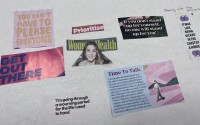
Ummmm… What’s next? Well, now, coloured post-its. Write down, write down the topics you want to discuss. Right, I wasn’t so sceptical anymore. Now I was more… just curious! Eager to catch a glimpse of new perspectives, because I didn’t use to talk about these things with other women. (Before this, at least) And then… what will happen? The post-its are regrouped, forming clusters, repeated topics emerge. We are nine, all very different, three of us from across the Atlantic; we are older, younger, and middle-aged; salaried, self-employed, juggling kids and the house, that is, working without pay; as fit as a whale or with those invisible disabilities that, because they’re not seen, are perhaps harder to deal with day to day, since one doesn’t immediately get understanding or support… but, oh… Wow! It turns out we’re affected by the same things: the incredible price of the buses, and rising; the lack of street lighting in a country where the night is soooooo long, just, only, nine of twelve months of the year; the cost of housing, the lack of support for those with caregiving responsibilities, have I mentioned the gaslighting from GPs? (yes? Oh, sorry, it must be the hormones). Hey, I thought these things only happened to me—but they don’t. The one 30 years younger, and the one 20 older, the one with no kids and the one with an extra one… no, it’s happening to all of us.
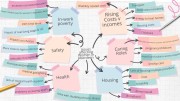
Yes, there’s room for apps too, and we made a mind map on Canva, to see what stems from each of the themes we’ve identified. Because, yes, all nodes have branches and sub-branches and sub-sub-branches. Bus fare: keeps me from moving freely, I get isolated at home, my mental health miss socialization… or if it’s a must, like having to take the kids to school, well… then I’ll have to cut back on something else. C’mon… yeah, I don’t see that well with these glasses anymore, but they’ll do for one more year. The dentist… Let me LOL.
A picture is worth a thousand words, they say, and another idea is to show in a mobile photo what poverty means to us: shopping trolleys full of yellow-label items, cheap, non-nutritious food that keeps the stomach full; the key to a home surrounded by the haze of a long-cherished dream…
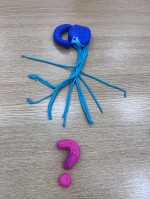
And here comes my favourite: modelling playdough, yes, we go back to childhood. The gatekeeper, the cordless phone… the difficulty isn’t even accessing services themselves but simply getting information about them—this takes shape in volume and pastel colours. What colour are paradoxes? Like those in a leaflet for an ESOL beginner’s course or for childcare grants to attend the course—that are only available in English. A teammate models a grid with little yellow rolls… if you don’t fit into any box… ohhhh… get ready to go round, and round. And round.
If old traditions placed women knitting around a table… in this project we’ve woven lists of worries, fears, hopes and dreams cut short by the lack of pounds around a paper tablecloth as our canvas, with markers instead of needles. But just the same, with many hands knitting together…
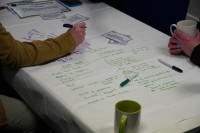
I also like mandalas. You have that little circle, and it grows, forming a design, intricate, complex, that from an outside perspective reveals clear patterns. That’s how I think our report has grown… like a mandala a collective mandala of experiences, needs, and hopes drawn by dozens of hands, those of the steering group and those of the young women, the travellers… all the other women of Aberdeen who attended the various focus groups, and the ones that answered the survey. I only hope our mandala won’t be like those sand ones created for meditation and then left to their fate and blown away by the wind.
It won’t be. Let’s not let it blow away.
May those reading—decision-makers, neighbours, allies—see in it something useful, something worth holding onto. And above all, may the wind not carry it away.
And tomorrow, one more parent will be able to choose whether to work part-time to stay home with their children or take on full-time hours, because the kids are well cared for, playing with others their age. And this winter, one more family will spend the afternoon at home, warm, having a nutritious snack, fresh food. And a young person over 22 won’t hesitate to go see that new exhibit at the Art Gallery because they can’t afford the bus fare. And there will be one fewer woman dreaming about the key to a safe, pleasant place to raise her daughter, who, by the way… when she grows into an independent woman will use gossip magazines to make collages of night walks down well-lit streets, post-its for a weekend excursion list in affordable public transport, and playdough to shape dolphins leaping in Torry.
 RSS
RSSMailing list
To join our email list, simply enter your email address below.