SWBG blog
Building a better Scotland requires a Feminist Just Transition
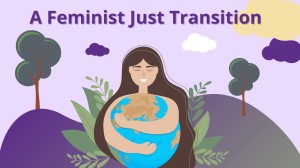
Beth Cloughton, Freelance Researcher, discusses the need for transformative change that can be achieved with a Feminist Just Transition.
Many view gender equality and climate justice as separate problems. However, they are consequences of the same system and must be remedied in unison for genuine, tangible, thorough, and improved change. Such a change can happen through a Feminist Just Transition (FJT).
The system responsible for the ecological, racial, and gender harms of today is capitalism, which in its contemporary form of neoliberalism, has led to an intensification of pursuing profit over the wellbeing of people and planet. When profit reigns supreme, gendered, racial, classed, and ecological harms are overlooked in favour of continued financial expansion of a minority of people, primarily men (for instance, 22 men in the world have more wealth than all women in Africa[i]).
In light of this injustice, the Scottish Women’s Budget Group (SWBG) undertook a scoping review at the start of 2023 to investigate a Feminist Just Transition here in Scotland, reviewing both Governmental and Civil Society approaches. We published a longer discussion paper outlining in more detail the relationship between gender inequality and climate injustice, while looking at specific policies, funding approaches, and global relationships required for climate and gender justice to emerge. What we found was that across both Government and Civil Society, there was limited integration of enacting climate justice alongside eradicating gender inequality.
Scottish Government addresses climate justice mainly via Just Transition policies generating Green New Jobs (GNJ). These GNJ, though important, replicate existing gendered labour disparities as the most polluting industries transition. Such jobs are male-dominated while female-dominated forms of employment are already low-carbon work, like care and education (Diski, 2022). This means women miss out on funding, which perpetuates underinvestment in women overall. Consequently, gender inequalities become entrenched rather than remedied.
From a global perspective, the Scottish Government has a more interlinked gender and climate policy approach. A global perspective is an essential move to address colonial powers and intersecting oppressions. This is seen in things like the Glasgow Women’s Leadership Statement, Climate Justice Fund, Women in Conflict 1325 Fellowship, and undertaking research with ClimateXChange on international climate justice, conflict, and gender, adopting a feminist approach to foreign policy.
However, the Government fails to look domestically at the relationship between climate justice and gender. Existing domestic policies do not thoroughly consider the global impact of at-home transitions. For example, promoting the adoption of clean energy via batteries has devastating ecological and social impacts outwith Scotland. Batteries require the mining of high-value minerals, found in places such as the Democratic Republic of the Congo which has the largest reserves of materials used in ‘green’ solutions. This mining devastates social and ecological environments and perpetuates exploitation of landscape and locals. As we look forward, incorporating a global outlook is crucial to any feminist approach to prevent exacerbating harms to women elsewhere.
For Civil Society, our sisters at the UK Women’s Budget Group, produced a core report about a ‘Green and Caring Economy[ii]’ with the Women’s Environmental Network. The report outlines how a radical shift to a gender and climate-just society could look and routes to achieve this aim. Of central importance is the promotion of a caring economy.
Beyond these ideas, a FJT challenges deeply rooted, powerful and stereotyped understandings of what it means to be ‘strong’ (Meyer, 2021; Nagel & Lies, 2022). ‘Strong’ and ‘strength’, synonymous with powerful, are associated with traditionally masculine ideas, often relying on tactics of extraction. It is unsurprising that approaches centred around care, interdependence, and cooperation have been side-lined, considered unrealistic and weak because of a ‘naturalised’ association to femininity (Aggestam et al., 2019; Robinson, 2019; Sultana, 2021). Yet, recognising our mutual dependency and enhancing communality, globally, reorients the economy as benefitting all people justly, not for the few.
To end, a Feminist Just Transition is an intersectional and transformational approach to build a sustainable, green and caring economy. The proposed approach prioritises care for people and planet. Working to build equality of women and marginalised groups domestically and globally, a FJT disrupts patriarchal and colonial power structures. A FJT is accountable, transparent, and timely, and allocates significant resources to achieve equity-based goals. The longer discussion paper hopes to provoke debate and generate conversations about these themes, in the hope of making the Feminist Just Transition a reality in Scotland, for women here and elsewhere.
References
Aggestam, K., Bergman Rosamond, A., & Kronsell, A. (2019). Theorising feminist foreign policy. International Relations, 33(1), 23–39. https://doi.org/10.1177/0047117818811892
Campbell-Stephens, R. M. (2021). Introduction: Global Majority Decolonising Narratives. In R. M. Campbell-Stephens (Ed.), Educational Leadership and the Global Majority: Decolonising Narratives (pp. 1–21). Springer International Publishing. https://doi.org/10.1007/978-3-030-88282-2_1
Diski, R. (2022). A Green and Caring Economy. UK Women’s Budget Group & Women’s Environmental Network. https://wbg.org.uk/analysis/greenandcaringeconomy/
Nagel, J., & Lies, T. S. (2022). Re-gendering Climate Change: Men and Masculinity in Climate Research, Policy, and Practice. Frontiers in Climate, 4. https://www.frontiersin.org/articles/10.3389/fclim.2022.856869
Robinson, F. (2019). Feminist foreign policy as ethical foreign policy? A care ethics perspective. Journal of International Political Theory, 17(1), 20–37. https://doi.org/10.1177/1755088219828768
Sultana, F. (2021). Climate change, COVID-19, and the co-production of injustices: A feminist reading of overlapping crises. Social & Cultural Geography, 22(4), 447–460. https://doi.org/10.1080/14649365.2021.1910994
Budgeting for equality, opportunity and community: the SWBG's asks for the Programme for Government
Our Coordinator, Carmen Martinez, reflects on how the Programme for Government 2023 to 2024 could work for women in Scotland.
The impact of the cost-of-living crisis has dominated the public debate for over a year. Individuals and communities have felt the consequences of increasing energy prices, more expensive basic goods, and higher mortgage repayments and rental costs. The problem, far from being resolved, threatens to deter progress towards agreed national and international goals, but most importantly, it threatens to erode the work towards women’s equality that organisations across Scotland have contributed to for so long.
Amidst the economic context and finance projections in the medium term, the Scottish Government’s missions for 2026,detailed in the new First Minister’s strategy, ‘A fresh start’ (Scottish Government, 2023), recognise three critical areas to improve the lives of people across the country:
- ‘Equality': 'tackling poverty and protecting people from harm’
- ‘Opportunity': 'a fair, green and growing economy’
- ‘Community': prioritising our public services’
We welcome the Scottish Government’s vision and commitments to these areas, as well as their approach to delivering these, including the acknowledgement of how these areas intersect and can feed into the Cabinets’ policy work. However, to ensure that this strategy works for women, this blog explores what the Scottish Women’s Budget Group (SWBG) would like to see as part of the next Programme for Government, and how this could be achieved.
1. Equality and the cost-of-living crisis.
Mounting evidence reveals the difficulties encountered by women as they navigate the current cost-of-living crisis. Women are more likely to work part-time and have caring responsibilities, which explain why they also have lower levels of savings and wealth compared to men (WBG, 2022). This is particularly true for women from Bangladeshi, Pakistani and Black ethnic groups, disabled women, single parents (of which at least 90% are women) (OPFS, 2020), survivors of abuse, unpaid carers, and women with no recourse to public funds (WBG, 2022). Our Women’s Survey 2023 exposed the implications of rising costs in Scotland and some of the mechanisms that women are currently using to cope with these. Some of the key findings showed us how:
- 23% of women respondents are taking on more debt. This figure rises to 40% for single parents.
- 41% of women stated that they are using their savings to make ends meet.
- The areas with the greatest impact of increased costs for women were energy and food costs with 46.3% of our respondents telling us they are struggling with energy costs and 37.1% with food costs.  For disabled women, these figures are even higher, with 56% and 51% respectively.  
An intersectional gendered analysis of these figures makes it obvious that women, especially disabled women and single parents, are at the losing end of the current economic crisis. In this context, and in line with the Scottish Government’s mission on equality, the SWBG would like to see the Programme for Government making explicit calls to prevent further inequality and increasing poverty rates amongst women by prioritising the following measures. First, the Scottish Government must widen eligibility for cost-of-living support and consider the additional costs that disabled people experience. This should be done in conjunction with any retrofitting and other energy efficiency measures targeting the poorest households, particularly those of disabled women and those with children. These actions would also prevent these households from getting into debt, while creating better living conditions for women and children. As an additional advantage, this action would have a positive impact on health outcomes.
We would also welcome the Scottish Government’s commitment to reducing transport costs. This is an important area for women as primary users of public transport, making shorter and more frequent journeys than their male counterparts. Our Women’s Survey 2023 also looked at women’s experiences of public transport and associated costs and found that 28% of respondents were struggling to manage transport costs, rising to 41% for disabled women and 54% for single parents. Furthermore, 53% of women stated being very dissatisfied or dissatisfied with the cost of public transport. Measures such as introducing price caps, widening access to free public transport provision to those in receipt of benefits, and investing in community transport schemes would have a great impact on women’s lives while contributing to Scotland’s commitments to Net Zero by 2045. Finally, the SWBG would urge the Scottish Government to invest in childcare. The average cost of full-time nursery for under two-years old represents 42% of the average wage in Scotland, or £1,106.52 per month (Daily Record, 2023), a substantial amount for any household, and especially for those already struggling with the cost-of-living crisis. Of the 199 women responding to our Women’s Survey 2023 who had childcare costs, almost 28% stated they struggled to manage childcare costs. This figure increases to 60% for women from ethnic minority communities. On top of the difficulties that this may pose to many parents, increasing evidence suggests that the lack of holiday childcare for children with disabilities is pushing families into poverty (ITV news, 2023). From this perspective, implementing a flexible childcare system that works for people, particularly mothers, is a key step to tackle poverty, and an obvious one to ensure that Scotland meets its gender equality goals (Scottish Government, 2020) as part of its 2030 Agenda.
2. Creating opportunity in a fair, green and growing economy that works for women.
The SWBG is supportive of Scotland’s Just Transition to a Net Zero and climate resilient economy and is aware of the opportunities that this transition could bring to communities across the country. In line with this argument, we are calling on the Scottish Government to make this transition feminist by recognising the role of care as essential social infrastructure and the untapped potential that the care sector has in delivering fairness and dignity while contributing to a low carbon economy.
Placing care as social infrastructure at the core of the Just Transition is also a key step to ensure gender equality, as women make up most of the care workforce, and most of unpaid carers. From this perspective, care can also be seen as a cross-cutting issue with implications for equality. Any economic strategy looking at creating opportunity in a fair economy must consider care work, so this is valued and compensated for, either through greater provision or through the support of a social security system which acknowledges the role of carers in society.
The challenge remains how to guarantee that appropriate levels of investment match the policy ambitions for a care system in urgent need of reform. Our care cost modelling research found that an increase in social care funding of £3.3bn is vital to realise the ambitions of a transformative scenario which would see:
- Increasing access to free care to those with critical needs and moderate needs.
- Increasing qualifications and pay to Nordic levels, with care workers paid an average of £15.21 per hour.
This scenario assumes that higher take-ups would relieve informal care needs further and eliminate unmet needs.
Most importantly, however, our care cost modelling research draws attention to the potential that investing in care has for revenue generation. For example, it calculates that additional direct and indirect tax revenue would yield an estimated additional £1.5bn annually (or 46% of the estimated additional investment required in the transformative scenario).
The SWBG would therefore like to see social care funding reach a total £6.8bn to make this transformative scenario a reality as part of Scotland’s approach to a Just Transition, while also contributing to the FM’s missions on opportunity and equality, in a fair, green and growing economy.
3. Building community via a caring social security system and a tax system designed to tackle inequality.
Public services, including social security, play a key role in women’s lives. Due to pre-existing inequalities and their role as primary carers, women are more likely to rely on social security for their income. Perhaps no other event has made the case for a gender-informed Welfare state than the austerity policies introduced in the UK in 2010, which has seen a wide range of organisations across the country reporting on the devasting effects for women ever since. Fast forward thirteen years, the harmful results of such an egregious set of measures are certain: greater inequality, increasing child poverty rates, and worsening health outcomes among others (Fawcett Society 2012; Marmot et al 2020; Social Mobility Commission, 2020). In the current context of cost-of-living, the need for strong public services is greater than ever, and as such, the SWBG believes that this should be reflected in this year’s Programme for Government. We would like to see the beginning of a caring social security system prioritising the following measures:
- Increase level of all Social Security Scotland payments by at least inflation annually;
- Mitigate the young parent penalty and the two-child limit through additional payments as part of the Scottish Child Payment;
- Ensure adequate funding for the Scottish Welfare Fund so there are sufficient resources to meet the demand and increase funding for promotion of the fund;
- Widen eligibility for cost-of-living support;
- Investment in a comprehensive programme of benefits take up.
Parallel to creating more robust public services and a social security system designed to protect people from the uncertainties of life, the Scottish Government must seek additional forms of revenue to build a fairer economy and to finance the (Feminist) Just Transition. We’ve previously mentioned how our care cost modelling research underlines the potential of investing in care for the wider economy, including for revenue generation. Yet, additional receipts derived from job creation within the sector would fall short when considering the cost of financing more comprehensive public services, including a fit-for-purpose security system. Therefore, we would invite Scottish Government to explore and pursue the following measures:
- Kick-start the long-stalled process to reform or replace Council Tax to raise more revenue in a fairer way;
- Commit to reviewing how new local taxes could be used to target wealth and make polluters pay;
- Lay the groundwork for more progressive Income Tax later this year, including by considering the introduction of new tax band;
- Develop carbon taxes, including use of powers on Air Departure Tax.
Putting it all together
‘Equality, opportunity and community’ are important missions covering key policy areas with the potential of making a huge difference in Scottish people’s lives. By using an intersectional gender analysis of the current economic environment, we have made the case for how these missions can better work for women. Inevitably, we contend that this analysis and calls made are critical to deliver fairness as well as greater equality outcomes. As such, we would urge the Scottish Government to include these as part of the next Programme for Government.
We understand the Programme for Government as an opportunity to correct the unwanted effects of a cost-of-living crisis preying on the most vulnerable, particularly women. On a more hopeful note, however, we see it as an opportunity to pave the way towards a more just, caring and resilient Scotland, ready for the challenges of the future.
REFERENCES
Fawcett Society. 2012. The Impact of Austerity on Women. Last accessed 26/07/23: The Impact of Austerity on Women | The Fawcett Society
ITV News. 2023. Lack of holiday childcare is pushing families with disabled children into poverty. Last accessed 26/07/23: Lack of holiday childcare is pushing families with disabled children into poverty | ITV News Granada
Marmot, M et al. 2020. Health Equity in England: The Marmot Review 10 Years On. The Health Foundation. Last accessed 26/07/23: Health Equity in England_The Marmot Review 10 Years On_full report.pdf
One Parent Families Scotland. 2020. The impact of poverty on single parent families Stories of Lived Experience 2019- 2020. Last accessed: 26/07/2023: OPFS-briefing-on-single-parents-lived-experience-july2020.pdf
Daily Record, 2023. Top 10 cheapest places parents pay for nursery costs in Scotland - and most expensive. Last accessed: 26/07/2023: https://www.dailyrecord.co.uk/lifestyle/money/nursery-care-costs-scotland-regions-29330714
Scottish Government, 2023. Equality, opportunity, community. New leadership – A fresh start. LAst accessed: 26/07/2023: https://www.gov.scot/publications/equality-opportunity-community-new-leadership-fresh-start/
Scottish Government, 2020. Scotland and the sustainable development goals: a national review to drive action. Last accessed: 26/07/2023: https://www.gov.scot/publications/scotland-sustainable-development-goals-national-review-drive-action/pages/8/
UK Women’s Budget Group. 2022. The gendered impact of the cost-of-living crisis. Last access 26/07/23: https://wbg.org.uk/wp-content/uploads/2022/03/The-gendered-impact-of-the-cost-of-living-crisis.pdf
Women's Budget Groups in Glasgow
Last month, the four Women’s Budget Groups (WBGs) from Wales, Scotland, UK and Northern Ireland travelled to Glasgow Caledonian University to participate in a two-day workshop on gender budgeting. Organised by Dr Angela O’Hagan, of the Scottish Women’s Budget Group and Glasgow Caledonian University, the workshop represented the first opportunity for all of the Women’s Budget Groups to meet in person and share updates on the current state of play within our respective nations. As well as advancing our collective gender budgeting agenda, we also discussed how to further bolster our cross-nation working, including expanding onto a 5-Nation basis by incorporating colleagues from the Republic of Ireland. Through fruitful and stimulating conversations, we were able to identify commonalities and nation-specific differences in the gender budgeting context, as well as develop a number of exciting plans for our upcoming collective endeavours.
Read below for the reflections of each of the Women’s Budget Groups, as well as an overview of what was highlighted in our cross-nation state of play discussions.
Scottish Women’s Budget Group (SWBG)
We were delighted to welcome all the Women’s Budget Groups to Glasgow. It was great to meet in-person after solely working online together and build on these relationships over the 2 days. We engaged, participated, and actively listened to one another as we spoke about each nation’s current progresses and challenges with gender budgeting. From the Scottish Women’s Budget Group, we discussed existing challenges in the political changes that occurred earlier in the year. However, our context remains comparatively stable with elements of progress, such as positive ministerial meetings, compared to other nations. We were also able to highlight our work with local authorities, an area of work that may be expanding for other WBGs in the future too. It was a very useful exercise to discuss with each other how we address and tackle common barriers we all face, especially around political will and receptiveness. These workshops created more cohesion amongst the 4 nations and a greater sense of togetherness, making sure we support one another in the overall goal of embedding gender budgeting in budgetary processes.
UK Women’s Budget Group (UKWBG)
Meeting with colleagues from the four nations plus the Republic of Ireland was an energising and inspiring experience despite the challenges we each face. The political instability in Westminster politics in recent years has made it harder to hold the Government to account for the lack of pre- and post-budget scrutiny. While we have had some significant policy successes, such as the expansion of the Conservative’s childcare offer in Spring Budget earlier this year (which requires significantly more funding than currently budgeted for), there remains a stark lack of engagement from the Treasury on the impact of budgetary decisions on gender equality and little regard paid the Public Sector Equality Duty. This was highlighted by the engagement our colleagues are able to have with the budgetary processes particularly in Scotland and Wales which, while far from perfect, put the lack of transparency of the UK Government to shame.
Wales Women’s Budget Group (WWBG)
It was a privilege to attend last month’s gender budgeting workshop in Glasgow. We were delighted to finally meet our sister organisations in-person and to participate in such interesting and productive conversations with colleagues and esteemed academics. The workshop’s state of play conversations proved particularly valuable, highlighting common problems and nation-specific differences with regards to embedding gender budgeting in budgetary processes, within the wider political context of a continuing cost of living and worsening housing crisis across the UK. From a Wales perspective, the WWBG was able to highlight that despite a comparatively stable political context and a continued commitment to gender budgeting within the Welsh Government’s Budget Improvement Plan and individual governmental departments, significant challenges remain. For example, a lack of capacity across Welsh Government and the public sector in Wales represents a crucial barrier to embedding gender budgeting, as does the complex legislative and regulatory landscape of Wales, which makes it harder to use certain levers to drive changes in behaviour. As the WWBG we will continue to work to address these issues and very much look forward to realising the exciting cross-nation plans developed at the Glasgow workshop.
Northern Ireland Women’s Budget Group (NIWBG)
After nearly three years of the 4-Nations project, it was an incredible experience to bring together the Coordinators and a few members of each of the WBGs in Glasgow to discuss how we can promote gender budgeting across the 5 Nations. While the current political and budget crises in Northern Ireland have brought serious barriers to furthering gender economic equality, gaining insights into the experiences of Scotland, England, Wales and the Republic of Ireland is crucial to our ability to apply examples of best practice and circumnavigate shared struggles. The main focus of the two-day meeting were the discussions around greater joined-up working across the 5 Nations through both academic and civil society channels. This would be a great asset to the NIWBG, as many decision-makers in Northern Ireland look to neighbouring jurisdictions for guidance and/or policy ideas. It is important that the NIWBG uses the insights provided through the 5 Nations connections to advocate and advise decision-makers in Northern Ireland, and guide them in the best direction for gender budgeting implementation.
Women's Survey 2023 Findings
Earlier this year we launched our Women’s Survey 2023 to find out more about women’s experiences of the cost-of-living crisis, transport and housing in Scotland.
We heard from 871 women across Scotland, receiving responses from every local authority area.
Cost-of-living crisis
It was evident from last year’s Women’s Survey that the cost-of-living crisis was a key concern for women, with 32% saying they were unable to manage energy costs before the increase in April 2022. Following this survey, our detailed qualitative research with the Poverty Alliance late last year highlighted powerful testimony about the impact of the cost-of-living crisis for women on low incomes in Scotland. This research highlighted that urgent action was needed as some women reported deepening experiences of poverty to the level of destitution by going hungry and cold. This year we’ve heard more experiences from women as costs continue to rise for households.
We hope this survey will highlight some of the intersectional, diverse lived experiences of women across Scotland as particular groups are more likely to be disproportionately impacted by poverty and insecurity such as disabled women, women from ethnic minority communities and single parents.
Some key findings:
- 70% of women have not been putting heating on to reduce costs, rising to 80% for women who earn under 20k
- Almost 20% are skipping meals entirely, which increases to almost 34% for disabled women and 46% for single parents 
- 65% of women said the cost-of-living crisis has impacted their mental health
- 41% of women are using their savings to manage rising costs, rising to 46% of women from ethnic minority communities and 47% for single adult households
- 53% of women in rural areas struggle to manage social care costs
Energy and food costs were the costs women struggled to manage most with 46% of our respondents struggling with energy costs and 37% are struggling with food costs.
The struggle of managing such costs has had a clear impact on women’s mental and physical health. In total, 65% of women said the cost-of-living crisis has impacted their mental health while 47% of disabled women are facing an impact on physical health conditions: “My stress levels have increased which puts an increase on my disability”
Many women reported instances that we would understand as acting like shock absorbers for poverty in their household. These include supporting family who are also struggling, making home adjustments to cut back on costs, and managing household budgets. In response to this, women in the survey called for lower energy, food and housing costs as well as consistent, targeted support for particular groups that are most affected by this cost-of-living crisis.
Women are also reporting taking on more debt and using their savings. This can result in a lack of financial support or buffer to help cope with rising costs. This experience of debt and savings is more exacerbated for particular groups of women such as women from ethnic minority communities, single parents and single adult households. Other impacts to women’s economic situation included changes to employment and retirement, with some women stating that they have had to take on more work to manage rising costs or feel they are unable to retire.
Social care provision in Scotland has been hugely impacted by the Covid-19 pandemic and has not been immune to recent rising costs. For women who had social care costs, 44% struggle to manage these costs. Other women have been faced with services not returning to pre Covid-19 levels. Women’s experience of accessing childcare is similar with rising costs and limited provision as 28% of women struggled to manage childcare costs, increasing to 60% for women from ethnic minority communities.
Recommendations in this report are informed by women’s responses, understanding that the response to the cost-of-living crisis is not short-term and will require longer-term action from both the Scottish Government and Local Authorities.
Some recommendations include:
- Increase level of all Social Security Scotland payments by at least inflation annually;
- Provide an urgent cash injection to support social care in the short-term while working towards a comprehensive; investment in care as set out in our report on social care;
- Continued delivery of progressive income tax reform;
- Invest in local authority council services and provide longer-term funding for third sector, community organisations; who provide critical financial wellbeing advice and support women in local areas.
You can access the first of our three reports, 'Experiences of rising costs across Scotland', here: SWBG-Cost-of-Living-report-proof-06.pdf
Transport
A key topic we wanted to explore in this year’s women survey was transport. As highlighted in our other Women’s Survey 2023 report, the cost-of-living crisis is impacting women hard. Transport is one of the rising costs that women are currently having to manage. In the survey, women told us about the challenges they face due to these costs, as well as the suitability of public transport and active travel, and safety concerns for travel in general.
Key findings include:
-
28% of women said they were struggling to manage transport costs, rising to 41% for disabled women and 54% for single parents;
-
53% of women stated they were very dissatisfied or dissatisfied with the cost of public transport;
-
48% of disabled women were either very dissatisfied of dissatisfied with the safety of walking and wheeling routes in their area.
We asked women about their main mode of transport and followed this up with more specific questions about their experiences as well as suggestions to improve public and active transport in their area. It became clear that many respondents’ main mode of transport was driving due to caring responsibilities, mobility issues, mental health needs, rurality, and employment needs:
“After school club ends at 5.30, I can stay at work until 5 if I drive. If I got the bus I’d need to leave at 4.30. This would mean reducing my hours and therefore income”.
However, some women, such as disabled women and women earning less than £20k, were more reliant on bus services and less likely to own a car than the overall respondent group.
Transport costs have not been immune to the impact of the cost-of-living crisis. 37% of women responding to the survey said that they had to change travel plans due to the cost of public transport. This rose to 42% for disabled women and 53% for women from ethnic minority communities.
When asked about if any of the women had changed their travel plans due to costs, some women reported increasing isolation and missing health appointments. One woman noted:
“I simply cannot afford to take public transport. Travelling to a medical appointment means skipping meals to afford the fare”.
Many women also told us that the cheaper and more reliable option for them was traveling by car.
There was an overwhelming message of dissatisfaction with public transport beyond rising costs due to lack of frequency, disjointed services with other modes of transport, inaccessibility, and safety. We were given plenty of suggestions for improving public transport in Scotland that included more regular buses and trains, more bus routes connected to amenities/services and an integrated system that includes ferries between all modes of public transport. Alongside issues with ferry timetables, long, indirect journeys provided barriers to accessing public transport for women living in rural communities. If you’d like to read more about the experiences of women from rural communities from our Women’s Survey 2023, read our Rural Briefing here: 1691675193_Womens-Survey-2023-Rural-Briefing.pdf (swbg.org.uk)
Physical barriers also existed for women travelling with wheels, either a pram or wheelchair:
“Public transport is not very accessible and mobility issues mean it is exhausting and painful to get around train stations”.
Overall, 47% of disabled women were very dissatisfied or dissatisfied with safety on public transport. These experiences are two-fold for disabled women due to physical safety onboard as well as personal safety due to fear of assault. From our overall respondent group, some women reported instances of assault or harassment, with fear of current services and provisions not protecting women enough. We were given suggestions about improving this safety with ideas such as guidance on report instances and more conductors or wardens to increase safety.
Active travel is also gendered as 59% of women who responded to the survey felt questions on access and safety of cycle routes was not applicable to them and 34% felt the same for walking and wheeling routes. Many women reported concerns about safety and routes for active travel that included a lack of dedicated cycling infrastructure and poor maintenance of cycling routes and pavements.
Recommendations are informed by women’s responses to the survey. These will require considered development and implementation from both national and local government in Scotland.
Some recommendations include:
-
Increase the use of intersectional gender budget analysis on transport decisions at national and local level. This recommendation cuts across both public transport and active travel planning processes to broaden and build equality into transport systems;
-
Widening access to free public transport provision to those in receipt of benefits including asylum seekers and cap the cost of public transport;
-
Improve safety awareness amongst transport staff including violence against women training for bus drivers and train conductors. As well as piloting schemes such as the ‘Between Stop Services’ in Montreal for women travelling alone, often at night.
You can access this report, 'Women's experiences of travel and its cost', here: Womens-Survey-2023-Transport-Report.pdf (swbg.org.uk)
Priorities for the new First Minister in building a gender equal economy
With many reflecting on the challenges ahead for Scotland’s new First Minister, this blog shares some of SWBG’s priorities for building a gender equal economy in Scotland.
During the leadership campaign Humza Yousaf made important commitments to expanding Scotland’s childcare offer to 1- and 2-year olds, starting from his first budget. Investment in childcare is a critical part of building a caring, gender equal economy. The UK has amongst the highest childcare costs across OECD countries. These costs keep parents, mostly mothers, out of employment; place huge financial burdens on families and are a driving factor in high poverty rates amongst single parents.
We look forward to seeing these commitments delivered within the next budget. We’ll be looking to hear from women across Scotland to support with our pre-budget advocacy later in the year. We’ll be running an update on last year’s survey that looked at how delivery of the 1,140 hours childcare commitment for 3- and 4-year olds was working for women, which showed that lack of flexibility in how these were delivered impacted on how beneficial they could be for women.
On top of this, urgent investment is needed in social care, formerly under Mr Yousaf’s Cabinet Secretary brief. The new First Minister declared that recovery and reform of the NHS and vital public services was an immediate priority in the job. Substantial investment in Scotland's social care support services needs to be part of this priority. As news recently broke of cuts to social care services funding in Glasgow and moves to outsource staff in West Lothian, the urgency of this is increasing if we are to address Scotland’s already crumbling social care services. A long-term strategy to further invest and improve social care support services to meet currently unmet needs; provide fair and well-paid work; and support people to meet their human rights is essential. The proposal made by the Scotland that Cares Campaign for a national outcome on care within the National Performance Framework to ensure action is driven to fully value and invest in care is one part of long-term change. Proposed cuts to services will make it even harder to create a National Care Service that transforms delivery of social care. SWBG research shows how much investment we believe is necessary to transform social care support in Scotland. Investing in care is about political decisions and we hope to see the new First Minister and his Cabinet take bold action to value, recognise and invest in Scotland’s care support services.
When dealing with the cost of living crisis, recognising the unequal impact of rising prices is critical. Our recent research with the Poverty Alliance on the impact of rising costs for women on low incomes highlights some recommendations needed from national to community level. These not only include short term relief measures but longer-term investment in areas such as care which are necessary to support long term recovery for people, communities and the economy. As debt rises for people the long-term outlook on how to provide solutions will be critical.
Humza Yousaf’s commitments to championing the rights of women and girls need to extend to how budget decisions are made. Bringing gender analysis into the process of budget setting and economic planning will help to tackle entrenched gender inequalities.
During the leadership contest SWBG joined with partners across the women’s sector in Scotland for candidates to commit to a range of measures to build a fairer more equal Scotland. Including investing in areas outlined in this blog, as well as, key commitments on ending violence against women and girls, protecting women’s right to abortion and incorporation of international convention, CEDAW, into the Human Rights Bill in Scotland. See more detail on these commitments in the full letter.
Along with our partners across the women’s sector we will continue championing these areas and seeking change to build a gender equal economy in Scotland.
 RSS
RSSMailing list
To join our email list, simply enter your email address below.