SWBG blog
Women’s Voices on the UK Budget: Reflections from Our Economic Empowerment Project
In this blog, our Training Lead, Heather Williams, shares the reflections of the women who are taking part in our second Economic Empowerment project.
What is a budget? This one, like those that have gone before, was a political occasion, except this was one that had been played out in the press for weeks before, with one policy trailed after another, testing the mood of the ‘nation’, or more accurately of the press pack and the opposition.
As the Chancellor stood last Wednesday to make her statement, was her priority ensuring the lines on the spreadsheet added up providing enough fiscal head room to keep the markets happy? Was it about keeping Labour MPs onside and keeping manifesto commitments? Was it about creating some positive headlines for what is seen by many in the press as a failing administration or about making decisions which make life better for people across the UK? In reality, it was probably about all of these.
But how did the decisions made land with a group of women from across Scotland? Our women’s economic empowerment group had mixed feelings about the Chancellor’s statement. They were pleased that the two-child limit had been abolished. Despite some of the headlines of the national newspapers about this being a budget for benefits street, there was a recognition of how self-defeating pushing children into poverty was as a policy choice.
The Chancellor’s statement that we will all have to pay a little more was questioned about what a little more to Rachel Reeves would look like for those on low incomes and how effective the measures she was taking to reduce household costs would be. There was little hope in the group that changes would curb the ever-increasing costs that households are facing.
The silence from the Chancellor on care was deafening! A quick check on the words used in her hour-long speech shows that she used the word tax 75 times, investment 36 and care on four occasions. The lack of any mention about the social care sector, which is crumbling across the UK, highlights an inability across governments to understand that investment in this area is needed if we are to generate economic growth.
The decision to limit the types of cars that can be accessed through the mobility scheme was a sop to the red tops and their mantra that the UK is a country of shirkers and strivers. That shirkers shouldn’t be rewarded. This policy change won’t save the treasury a penny as the amount subsidised is the same if a disabled person uses it for a BMW or a Ford. All this decision does is send the message that disabled people don’t deserve to have access to the same things as others in society as they are seen as shirkers, an example of groups being pitched against each other.
Another lesson from this budget is never believe a politician that tells you that they will not raise taxes! Or who treats tax like it’s a shameful thing failing to recognise the contribution taxes make towards the services we receive.
Some of the women on this group have direct experience of the harm caused by the failure to invest in public services. They were clear that further investment was needed particularly in areas like social housing, social care and violence against women services. As we look forward to the Scottish Government’s budget statement in January, these are some of the areas women hope to hear more about than we did from the Chancellor.
Don´t let the wind blow our mandala
In this powerful blog, Arantxa Garcia de Sola — a member of the project’s Steering Group — reflects on her experience contributing to the newly published report on Poverty and Inequality in Aberdeen.
I’m someone who writes. I even find it easier to express myself in writing than when speaking. It’s not because of English—it’s not my mother tongue, no- but it’s the same in my beloved Spanish. And maybe that has something to do with one of the things I’ve really loved about being part of the steering group for this project. For me, it’s been new and fun to work with so many different ways of expressing things — discovering how to pull something out of the brain, the heart, or the gut… without writing a text longer than what fits in a post-it, sometimes not even using words.
First day: pile of gossip magazines, cut out, cut out and present what problems women with limited resources face in this humid and windy city in the northeast of Scotland, Aberdeen (humid and windy are my words ?). I expressed my scepticism: “With those magazines?” I swallowed my scepticism. There, among the news about British and international celebrities, was hidden the often-present mold in the flats of the granite city, the double workday inside and outside the home, menopause, periods, gaslighting from GPs who see everything as hormonal…
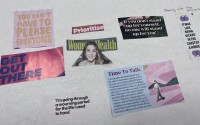
Ummmm… What’s next? Well, now, coloured post-its. Write down, write down the topics you want to discuss. Right, I wasn’t so sceptical anymore. Now I was more… just curious! Eager to catch a glimpse of new perspectives, because I didn’t use to talk about these things with other women. (Before this, at least) And then… what will happen? The post-its are regrouped, forming clusters, repeated topics emerge. We are nine, all very different, three of us from across the Atlantic; we are older, younger, and middle-aged; salaried, self-employed, juggling kids and the house, that is, working without pay; as fit as a whale or with those invisible disabilities that, because they’re not seen, are perhaps harder to deal with day to day, since one doesn’t immediately get understanding or support… but, oh… Wow! It turns out we’re affected by the same things: the incredible price of the buses, and rising; the lack of street lighting in a country where the night is soooooo long, just, only, nine of twelve months of the year; the cost of housing, the lack of support for those with caregiving responsibilities, have I mentioned the gaslighting from GPs? (yes? Oh, sorry, it must be the hormones). Hey, I thought these things only happened to me—but they don’t. The one 30 years younger, and the one 20 older, the one with no kids and the one with an extra one… no, it’s happening to all of us.
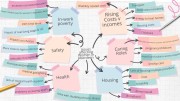
Yes, there’s room for apps too, and we made a mind map on Canva, to see what stems from each of the themes we’ve identified. Because, yes, all nodes have branches and sub-branches and sub-sub-branches. Bus fare: keeps me from moving freely, I get isolated at home, my mental health miss socialization… or if it’s a must, like having to take the kids to school, well… then I’ll have to cut back on something else. C’mon… yeah, I don’t see that well with these glasses anymore, but they’ll do for one more year. The dentist… Let me LOL.
A picture is worth a thousand words, they say, and another idea is to show in a mobile photo what poverty means to us: shopping trolleys full of yellow-label items, cheap, non-nutritious food that keeps the stomach full; the key to a home surrounded by the haze of a long-cherished dream…
And here comes my favourite: modelling playdough, yes, we go back to childhood. The gatekeeper, the cordless phone… the difficulty isn’t even accessing services themselves but simply getting information about them—this takes shape in volume and pastel colours. What colour are paradoxes? Like those in a leaflet for an ESOL beginner’s course or for childcare grants to attend the course—that are only available in English. A teammate models a grid with little yellow rolls… if you don’t fit into any box… ohhhh… get ready to go round, and round. And round.

If old traditions placed women knitting around a table… in this project we’ve woven lists of worries, fears, hopes and dreams cut short by the lack of pounds around a paper tablecloth as our canvas, with markers instead of needles. But just the same, with many hands knitting together…
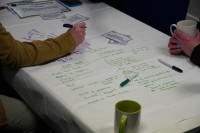
I also like mandalas. You have that little circle, and it grows, forming a design, intricate, complex, that from an outside perspective reveals clear patterns. That’s how I think our report has grown… like a mandala a collective mandala of experiences, needs, and hopes drawn by dozens of hands, those of the steering group and those of the young women, the travellers… all the other women of Aberdeen who attended the various focus groups, and the ones that answered the survey. I only hope our mandala won’t be like those sand ones created for meditation and then left to their fate and blown away by the wind.
It won’t be. Let’s not let it blow away.
May those reading—decision-makers, neighbours, allies—see in it something useful, something worth holding onto. And above all, may the wind not carry it away.
And tomorrow, one more parent will be able to choose whether to work part-time to stay home with their children or take on full-time hours, because the kids are well cared for, playing with others their age. And this winter, one more family will spend the afternoon at home, warm, having a nutritious snack, fresh food. And a young person over 22 won’t hesitate to go see that new exhibit at the Art Gallery because they can’t afford the bus fare. And there will be one fewer woman dreaming about the key to a safe, pleasant place to raise her daughter, who, by the way… when she grows into an independent woman will use gossip magazines to make collages of night walks down well-lit streets, post-its for a weekend excursion list in affordable public transport, and playdough to shape dolphins leaping in Torry.
Beyond Scotland: what does childcare look like elsewhere?
Over the past year, the Scottish Women’s Budget Group has been exploring different aspects of Early Learning and Childcare (ELC)-(2)-220.png) policy in Scotland: from affordability to flexibility (or lack thereof) of services, to the economic impact of investing in childcare (both in the short and long term). While these webinars have touched on some international examples of best practice, the last event of the series sought to address a question left untouched: what does childcare look like elsewhere? The webinar heard from speakers from Canada, France and Estonia.
policy in Scotland: from affordability to flexibility (or lack thereof) of services, to the economic impact of investing in childcare (both in the short and long term). While these webinars have touched on some international examples of best practice, the last event of the series sought to address a question left untouched: what does childcare look like elsewhere? The webinar heard from speakers from Canada, France and Estonia.
Third order change. Childcare developments in Canada.
Susan Prentice, Duff Roblin Professor of Government at the University of Manitoba, kicked us off with an overview of the latest developments in Canada’s childcare system. Up until 2021, Canada was one of the lowest spenders on ECL among OECD countries: there was no country-wide programme, no entitlement, no plan for building a system, and limited public funding. High fees and low overall access were two of the most notorious features of the system, which offered no public provision of any kind.
Following decades of advocacy efforts and as a consequence of the pressures created by Covid, in 2021 the Government published its Canada-wide Early Learning and Childcare Plan (CWELCC), alongside its federal budget of 2021. It committed to building a system of affordable, inclusive, high quality “early learning and childcare for all” children below school age, backed by $30 billion to be spent over 5 years. The provinces and territories were responsible for the implementation of CWELCC. While differential approaches were taken, one the plan’s key features – the promotion of affordable childcare at a cost of $10/day to parents – has been delivered across the country. Similarly to what we saw in the previous webinar on ‘Is investing in childcare worth it?’, the economic returns of this investment are clear and quantifiable. For example, studies in Quebec have found returns on investment of more than $3.50 for every $1 spent on childcare.
But the question that Susan really wanted us to reflect on was... is this the type of radical and rare shift in policy (or “third order change”) that Paul Cairney, Professor of Politics and Public Policy at the University of Stirling refers to in his book ‘Understanding Public Policy’? And, in addition, will CWELCC become part of Canada’s social infrastructure?
Susan shared that the rollout of the policy has been messy. While federal conditions were clearly set out to ensure “affordability”, there was less clarity around expansion, inclusion, workforce recruitment and the quality of care available. Parallel to this, there is the paradox that low prices created “induced demand” and, with this, a perception that the policy is failing – this is being exploited by the Government’s opposition. And while limiting childcare costs to $10/day might remain in place under a different Government, other crucial objectives of the policy – such as the expansion of services through non-profits and public delivery, or stabilizing the childcare workforce – will most likely disappear from (a likely) new Government’s list of priorities, and with it, the idea of this policy being an example of ‘third order’ change.
Childcare in France
France’s childcare system is not exempt from challenges. Our second speaker, Nathalie Casso-Vicarini, an early childhood educator and the founder and managing director of the association “Ensemble pour la petite enfance”, stressed that the debate about public versus private childcare provision is a hot topic in the country. The level of public funding provided is 50%, with families contributing an amount depending on their financial circumstances, making the system affordable. Yet only 5% of children living under the poverty line have access to childcare centres. This very low level of access is a problem, as child poverty affects 1 in 5 children in France.
The French system relies on public and private settings, with a market share of 70% and 30% respectively. However, private settings are made up of big companies which sacrifice quality of care in pursuit of profit. In terms of accessibility of childcare, services are available to children from 10 weeks old to three years of age. While this level of access is positive, having the best interest of the child at heart means offering a nurturing environment as well, and for this, the training requirements of the workforce are key. In this regard and following on from the ‘First 1000 Days’ commission set up by President Macron in 2019, France has developed a framework to regulate the quality of care across all social services, including children’s services.
One example of evidence-based best practice in France is the ‘Houses of the first 1000 days’ (the Maisons des 1,000 Premiers Jours), a network of centers that support parents and young children from conception to two years old. 80% of couples join this network, which, among other objectives, aims at reducing mothers’ feelings of isolation which is a risk factor for children’s development.
Despite initiatives such as this and the wider focus on improving quality of care, France’s journey towards a childcare system that delivers more equitable outcomes is an unfinished task. Nathalie’s organisation sees the following five steps as a prerequisite to reach this objective:
- Better maternity and paternity policies (minimum of 6 months at 80% of the salary);
- Building confidence with all families through the ‘Houses of the first 1000 days’ with the aim of tackling poverty;
- Ensuring that the ELC workforce have access to high quality training;
- Providing access to public and affordable childcare for all children from the age of 6 months;
- Ensuring access in both rural and urban areas; and
- Continued evaluation of care quality by analysing data to ensure progress.
Is Estonia’s kindergarten model the way to go?
Ulle Matsin, Head of the Educational Policy Department at the Ministry of Education and Research in Estonia, explored the reasons behind Estonia’s strong performance in the OECD’s Programme for International Student Assessment (PISA), pointing towards the country’s quality of preschool education, which is an integral part of the country’s educational system.
Pre-school education is primarily delivered to children between the ages of 18 months to 7 years in specially dedicated educational institutions: mainly kindergartens, but also general education schools with kindergarten groups. However, the country also has childcare service providers (the majority of which are private). Pre-school education involves a learning curriculum and substantive methodological activities. Regarding costs, local government sets the fees for children attending kindergarten, which need to be covered by parents alongside food costs. However, fees cannot exceed 20% of the country’s minimum salary as set out by the Government.
Because not all families are able to get a place in a kindergarten, the Government is working to align the quality of childcare services. A new draft of Estonia’s Early Childhood Education Act has been submitted to the country’s Parliament for this purpose. Once the reviewed Act passes, all childcare services (the majority of which are private providers) will be under the control of the Ministry of Education and Research, meaning that childcare services will need to meet the same quality standards as kindergartens. This piece of legislation also aims to ensure that special support is provided in kindergartens to children with additional support needs, as already happens in school age settings.
Conclusion
This webinar shone a light on the importance placed on the affordability of childcare in the three countries discussed. It reinforced the possibilities that affordable childcare can provide for women’s employment and for the state in the form of additional tax revenues through expanded parental employment. Indeed, Canada’s recent developments should serve as a reminder that investing in social infrastructure pays off. Yet, despite progress being made, most countries are grappling with different issues, the most common of which seems to be ensuring equitable access to childcare and ensuring high quality of care is provided. Estonia’s efforts to ensure both these issues are addressed should serve as an example of what can be achieved when Governments’ determination is put to test.
You can review the previous webinars in this series here:
Scottish Women’s Budget Group | SWBG blog | What’s wrong with childcare in Scotland? A summary
Scottish Women’s Budget Group | SWBG blog | Flexible childcare, an ideal or a necessity? A summary
Scottish Women’s Budget Group | SWBG blog | Is investing in childcare worth it? A summary

This webinar series is supported by Oxfam Scotland
Reflecting on the Scottish Draft Budget 2025-2026
While it’ll take some time to go through all the budget documentation, including equality impact assessments, and delve into the detail of the Equality and Fairer Scotland Statement, our first take on the budget is that it offers glimmers of hope for women who are feeling the crunch of years of rising prices. Yet more still needs to be done to invest in care and raise further revenue to support public services.
The headline grabbing commitment to scrap the 2-child limit is a much needed and welcome decision that cannot come soon enough for families affected by the policy. Ideally this is an action that would change at source with the UK Government scrapping the harmful policy, rather than Scotland’s limited budget envelope being used to mitigate UK actions. Time will tell how the two governments negotiate the delivery of this policy. What must stay front of mind through this process is the families impacted by it and the potential to lift 15,000 children out of poverty.
Although there’s difficulty comparing information to the current year’s budget due to changes made in reporting, some additional support for public services was announced, including the NHS and social care, and funds for local government. However, the Budget has fallen short of the investment required to make childcare more accessible, and to correct years of underinvestment in care services which are key for women.
In terms of reporting, it is welcome that the Government has tried to show the 2025-26 Budget against actual spend over the last year. However, there remains room for more transparency behind the figures to support budget scrutiny. We’ll share more on this in our full analysis from a gender budgeting perspective to be published later this month.
A short breakdown of the high (or low) lights from us:
On social care
After decades of underfunding, today’s commitments do not go far enough to meet the needs of this critical sector in the economy. This does a disservice to all those in need of social care support, the workforce (majority of whom are women) and unpaid carers who are picking up the pieces of underfunded services.
Within this we are disappointed that the government failed to commit funds to end social care charges. A policy the government has committed to by the end of this Parliament in 2026. We know from our work with Glasgow Disability Alliance’s women’s group that these charges are impacting disabled women’s lives and financial and care decisions they are making daily.
On childcare
This year’s budget maintained funding to childcare as set out in the 1140hours policy, which will likely see no changes to the way in which this policy is delivered, and no further expansion. Women responding to our childcare survey last year highlighted that a lack of flexibility in delivering early learning and childcare hindered access for some women. We know that the cost of childcare for 1- and 2-year-olds is severely impacting families’ finances, particularly women’s. Research by Pregnant then Screwed Scotland found that 4 in 5 (83.7%) mothers say they often feel childcare costs are the same or more than their income – meaning some parents are in fact, paying to work (1).
As with social care wages for staff in childcare are set at the real living wage as a minimum. This fails to take into account the need to view care work as skilled work and set wages that reflect this skill.
On Scottish Social Security
As mentioned at the top of this blog, the commitment to scrap the two-child limit has been the focus of a lot of attention on social security announcements alongside the changes to reinstate a winter fuel payment to all pensioners after means testing was introduced this year.
Changes were also made to the earnings threshold for Carers Support Payment, reflecting changes made for England and Wales. These are welcome but as this new payment comes into fully devolved control, further work on its rate and eligibility is necessary to recognise the work of unpaid carers and the levels of poverty they and their families experience.
The remainder of Scotland’s social security payments are set to rise by inflation rates set in September CPI which was 1.7%. This fails to take into account analysis laid out in the Scottish Fiscal Commission reports of expected inflation rates of 2.6% in 2025-26. This is continuing the UK Government’s failure to provide a genuine safety net to those who need it in our society.
Standstill funding for the Scottish Welfare Fund is likely to prove problematic as the fund needed topped up this year due to levels of demand. For those facing crisis situations, this is a vital lifeline that needs properly resourced and promoted.
On violence against women and girls funding
Commitment to funding the Delivering Equally Safe strategy through 2025-26 is vital for essential violence against women and girls services. While the Budget included resources for the coming financial year, these services need long-term multi-year funding settlements to ensure they can plan and deliver high quality support to women escaping domestic abuse.
On public sector pay
It’s good to see the Scottish Government publishing a pay policy alongside the Budget this year to give greater transparency on decision making. Although the Scottish Fiscal Commission have highlighted potential fiscal risks as they did not have workforce information during the forecasting process.
Women make up a significant proportion of public sector workers, often in lower paid and undervalued roles. The pay policy sets a broad envelope for public bodies but leaves final decisions to the individual bodies. Work to ensure equalities considerations are part of these decisions will be an important measure in tackling Scotland’s gender pay gap, which has risen in the last year.
On tax
The Scottish Government missed an opportunity to build more progressive tax actions into this year’s draft budget.
The end of the Council tax freeze will be welcomed by stretched Local Authorities, as well as the funding settlement from central government. Alongside others in the Tax Justice Scotland coalition, we called for a commitment to the revaluation of Council Tax bands to start the process of developing fairer local tax which supports our public services. This budget missed the opportunity to kickstart this overdue process, consequently failing to increase much needed extra revenue.
Small but important income tax changes for those on lower incomes were announced such as the raise of the threshold for basic and intermediate rate taxpayers. This decision will benefit women, who are more likely to be in these bands, and will maintain a progressive income tax policy.
The Budget was accompanied by the publication of a tax strategy which SWBG will be analyzing to consider how it will work to advance equality and maximise available resources in Scotland. Watch this space for a blog with our reflections.
While negotiation on Employers’ national insurance contributions between the Scottish and UK Governments will continue over the coming days and weeks, the Scottish Budget was silent on support to commissioned services and the voluntary sector. Care services (both social care and childcare) are likely to be hit hard by the changes, having a disproportionate impact on women who make up the vast majority of the care workforce.
On equalities analysis
Alongside the budget documentation is the publication of the Equality and Fairer Scotland Budget Statement. The aim of this document is to bring together how information on equalities has informed budget decision making. This is an important statement of intent by the government. The work put into the development of this publication during the budget process provides an important focus on equality considerations.
Additionally, multiple equality impact assessments have been published, for example relating to the Tax Strategy. The publication of these documents is a welcome step to increase transparency, and we look forward to reading the details to see how equality considerations have informed policy choices.
SWBG will be publishing our more detailed analysis of the Scottish Budget and how it measures up to the principles of gender budgeting in the New Year.
--
Responding to news of the delay of stage 2 of the National Care Service (Scotland) Bill
The delay announced by the Minister for Social Care may not come as a surprise to anyone. The process for developing the National Care Service (Scotland) Bill has lost sight of the vision shared by those who use care services and carers in the development of the Independent Review on Adult Social Care.
What cannot be delayed is much needed investment in care services. Cuts to care services are being made, or are on the horizon, across Scotland. These cuts are reducing who is able to access care support services, will increase unmet need, and impact on the amount of unpaid care support that is required, which women deliver the majority of.
We know that women cannot wait for investment in care services. With the process for the Bill delayed we look to the forthcoming budget to bring much needed additional investment in care. With the focus of this investment seeking to improve outcomes for those who use care support services, reduce unpaid care demands, and deliver fair work for those in the social care workforce. For women receiving care support and as paid and unpaid carers this is a critical time for action.
For more information, please contact Sara Cowan, sara.cowan@swbg.org.uk 0141 648 7673
For details about the levels of long-term investment needed to transform social care support services in Scotland see our modelling research here.
 RSS
RSSMailing list
To join our email list, simply enter your email address below.